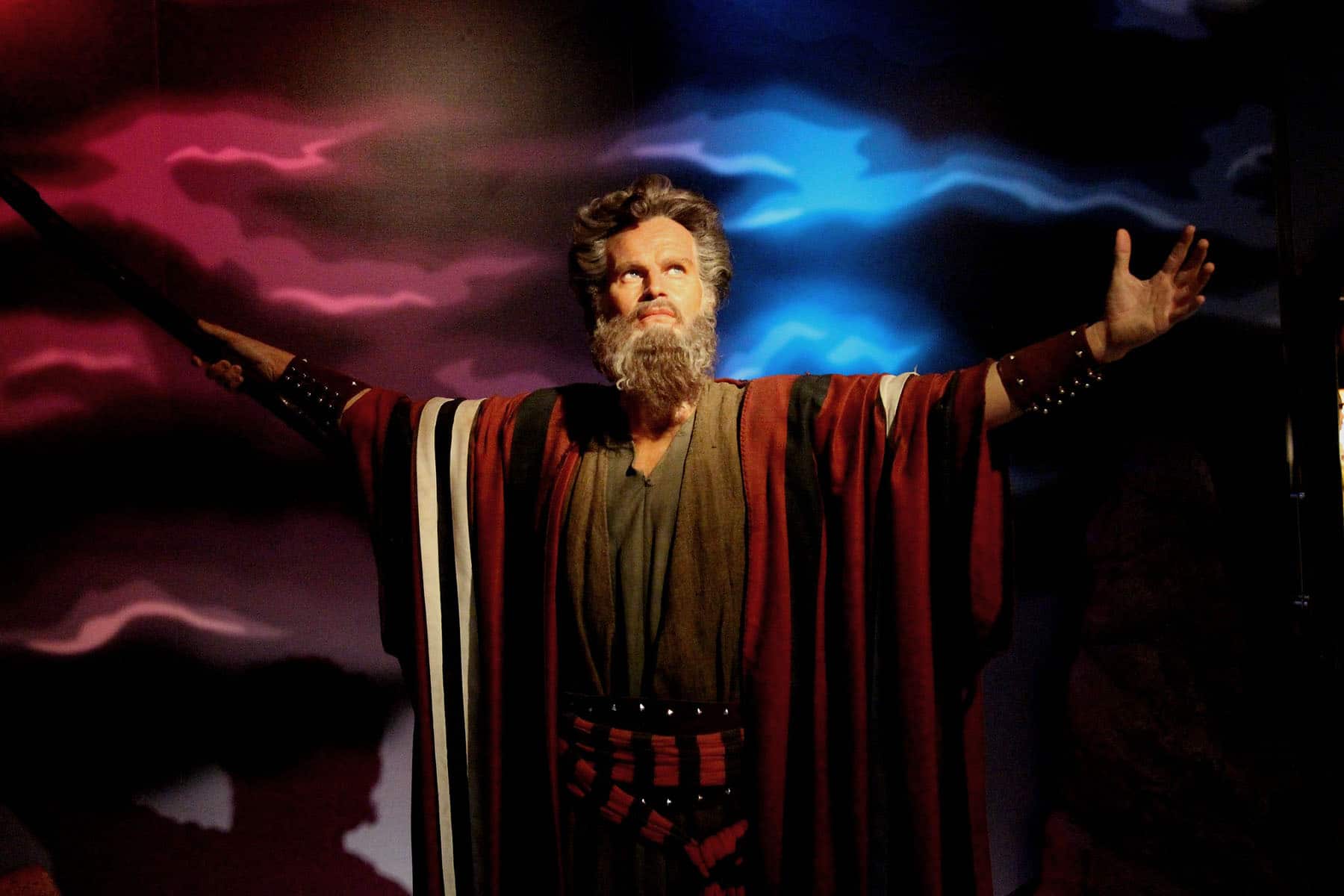
In The Ten Commandments at the Burning Bush when Moses, Charlton Heston,
was addressed by none less than great God Almighty,
Cecil B. DeMille did not know whose voice he should use for God. He wasn’t jestin’,
when he chose Charlton, gunman, not yet righty.
The voice of God he chose to speak to Moses was his Jewish father, Amram;
the fire that melts young Moses’ modest ice is
the sudden flame of insight to his roots, and hearing God explain “I Am Who I Am,”
thus ending his disturbed identity crisis.
‘The Ten Commandments’, the film, was made in 1956, when Charlton Heston was still a liberal Democrat.
Rabbi Meir Soloveichik, in one of his Bible 365 podcasts, points out that Cecil B. DeMille suggested that the voice of God addressing Moses from the Burning Bush should be that of his father, Amram. He follows Rabbi Lord Jonathan Sacks’s interpretation of Exod. 3:11:
יא וַיֹּאמֶר מֹשֶׁה, אֶל-הָאֱלֹהִים, מִי אָנֹכִי, כִּי אֵלֵךְ אֶל-פַּרְעֹה; וְכִי אוֹצִיא אֶת-בְּנֵי יִשְׂרָאֵל, מִמִּצְרָיִם. 11 And Moses said unto God: ‘Who am I, that I should go unto Pharaoh, and that I should bring forth the children of Israel out of Egypt?’ God had introduced himself to Moses in Exod. 3:6 as the God of his ancestors:
Moses however still asks מִי אָנֹכִי, who am I? This is not a rhetorical question, asked in order to indicate his modesty. He asks this question because he suffers from an identity crisis.
The first word after the first verse of the Shema in Deut. 6:4 is ואהבת, v’ahavta , commanding all Israelites to love God. The medieval commentator Ba’al HaTurim explains that this word contains the letters האבות, ha’avot, the forefathers, thereby implying that all Jews who recite the first verse of the Shema should follow the God-loving paradigm followed by Abraham, Isaac and Jacob. This not only foreshadows Rabbi Sacks’s explanation of God telling Moses that He was the God of the patriarchs, but also Cecil B. DeMille’s decision to imply that God, when speaking to Moses, uses the voice of Moses’ own father, Amram.
Gershon Hepner is a poet who has written over 25,000 poems on subjects ranging from music to literature, politics to Torah. He grew up in England and moved to Los Angeles in 1976. Using his varied interests and experiences, he has authored dozens of papers in medical and academic journals, and authored “Legal Friction: Law, Narrative, and Identity Politics in Biblical Israel.” He can be reached at gershonhepner@gmail.com.