It is the season of giving thanks. It is the season of looking at our lives and counting our blessings. And in a world in which we are positioned to count the blessings of others, cultivating gratitude isn’t always the easiest of practices.
When Jacob and Esav reunite, the brothers try to appease each other by giving gifts. Esav says to Jacob, “I have much, my brother; let what you have remain yours.” Jacob responds, “Please accept my present which has been brought to you, for God has blessed me and I have everything.”
The Kli Yakar, a 17th century commentator, explains the difference in their approaches. Esav says that while he has much, it’s not everything. There are those that have and have and have and still see very little within their hands. And of course, the opposite. Like Jacob, one might possess very little, but to them, it is everything; more than enough.
The cultivation of gratitude is the ability to wake up and be content in knowing, today, I have everything. Because I woke up, I have everything. You may still desire to do more; to achieve more, to rise higher. You must still contribute to a world that is need of your hands and your heart. But it begins with a recognition of God’s gift to you: this very day. And with this gift, you don’t just have much…you have everything.
May it be a season of recognizing one’s blessings. The blessing of life. And the blessing of giving back…because we can.
Thank God for that.
Shabbat Shalom
Rabbi Nicole Guzik is senior rabbi at Sinai Temple. She can be reached at her Facebook page at Rabbi Nicole Guzik or on Instagram @rabbiguzik. For more writings, visit Rabbi Guzik’s blog section from Sinai Temple’s website.
Whether our prologue be in heaven or
on earth, the counting of the stars above
or grains of sand that line the beachy shore,
our epilogue is peace and love.
Men can’t do anything without some make-
believe, as Abraham found out, but try
interpreting their dreams when they’re awake,
because they think that sleeping dogs can’t lie.
Recall this fact concerning peace and love.
Make-believe is a big-bang beginning,
like that which made the sun and stars above
before life on other planets round them spinning.
Abraham’s attempt to save in Sodom
the lives of people who were innocent
implies that justice’s big bang has a bottom
that’s false, unless the fall guys who aren’t innocent repent.
Gen, 14:18-19 states:
וּמַלְכִּי־צֶ֙דֶק֙ מֶ֣לֶךְ שָׁלֵ֔ם הוֹצִ֖יא לֶ֣חֶם וָיָ֑יִן וְה֥וּא כֹהֵ֖ן לְאֵ֥ל עֶלְיֽוֹן׃
And King Melchizedek of Salem brought out bread and wine; he was a priest of God Most High.
וַֽיְבָרְכֵ֖הוּ וַיֹּאמַ֑ר בָּר֤וּךְ אַבְרָם֙ לְאֵ֣ל עֶלְי֔וֹן קֹנֵ֖ה שָׁמַ֥יִם וָאָֽרֶץ׃
And he blessed him, saying, “Blessed be Abram of God Most High,
Creator of heaven and earth.
The king of Sodom says to Abraham in Gen.14:21 that his only desire is that Abraham
transfer to him the hostages whom he had rescued:
וַיֹּ֥אמֶר מֶֽלֶךְ־סְדֹ֖ם אֶל־אַבְרָ֑ם תֶּן־לִ֣י הַנֶּ֔פֶשׁ וְהָרְכֻ֖שׁ קַֽח־לָֽךְ. Then the king of Sodom said to Abram,
“Give me the persons, and take the possessions for yourself.”
God who had facilitated Abraham’s victory, implies that his reward
will be his numerous descendants, whose number will be as difficult
to count as the stars in heaven. Abrahams response to God’s promise is stated in Gen. 15:6:
וְהֶאֱמִ֖ן בַּֽיהֹוָ֑ה וַיַּחְשְׁבֶ֥הָ לּ֖וֹ צְדָקָֽה׃ And he trusted YHWH, who reckoned this to be justice.
Isa. 1:25 states:
וְאָשִׁ֤יבָה שֹׁפְטַ֙יִךְ֙ כְּבָרִ֣אשֹׁנָ֔ה וְיֹעֲצַ֖יִךְ כְּבַתְּחִלָּ֑ה אַֽחֲרֵי־כֵ֗ן יִקָּ֤רֵא לָךְ֙ עִ֣יר הַצֶּ֔דֶק קִרְיָ֖ה נֶאֱמָנָֽה׃
And I will restore your magistrates as of old, And your counselors as of yore.
After that you shall be called City of Righteousness, Faithful City.”
In “Did Trump’s Supreme Court Tariffs Brief Include a Strategic Blunder?,” NYT, 11/7/25,
Adam Liptak writes an article that seems to support my suggestion that
the language linking the debate between Abraham and God regarding
God’s intention to destroy Sodom implies that rationale for the biblical
record of this debate is to teach all readers the biblical attitude
regarding the harming of innocent victims in a justifiable war
against a guilty nation. Adam Liptak writes:
The justices are generally reluctant to take account of a president’s public statements.
But extensive quotes from Mr. Trump in a key filing may change the legal calculus.
Gershon Hepner is a poet who has written over 25,000 poems on subjects ranging from music to literature, politics to Torah. He grew up in England and moved to Los Angeles in 1976. Using his varied interests and experiences, he has authored dozens of papers in medical and academic journals, and authored “Legal Friction: Law, Narrative, and Identity Politics in Biblical Israel.” He can be reached at gershonhepner@gmail.com.
In 2013, there was an uproar when Justin Bieber visited the Anne Frank House in Amsterdam and wrote in the guest book, “Anne was a great girl. Hopefully, she would have been a belieber,” or a fan of his. Was Bieber, then 19, perhaps a bit arrogant? Sure. Did he do something terrible? Not at all.
With rising antisemitism and little Holocaust education in America, it is understandable that people would be furious and consider any satire involving Anne Frank an attack on Judaism. When you get punched in the face so many times, it makes sense to have your guard up. But one must see the actual work and then judge.
I’ve interviewed about 50 Holocaust survivors, have written about antisemitism, interviewed Jews beaten on the streets of New York for being Jewish and have seen or reviewed nearly every Holocaust-related film.
Here is a good litmus test to do on yourself: Did you refuse to see “The Producers” because it’s a comedy that includes a singing Hitler? When Larry David, on “Saturday Night Live,” wondered aloud whether or not he would have a good pickup line if he was in a concentration camp, were you infuriated? Lastly, if you saw the Israeli sketch comedy show “Eretz Nehederet” which jokes about Yahya Sinwar, the late Hamas leader and architect of the Oct.7 attacks, was it too much for you? If so, “Slam Frank” is not for you.
In an online interview, Andrew Fox, the musical’s composer and lyricist, said that the catalyst for the show was his disbelief when reading the viral tweet: “Did Anne Frank acknowledge her white privilege?” Of course, Frank didn’t have much privilege; she died in a concentration camp because she was Jewish.
The show’s website includes the explanation: “Our musical satire imagines what happens when a progressive community theater company decides, you know what, maybe now is not the time for us to center these privileged, straight, white European Jews (who spent three years in an attic, hiding from Nazis). And so, in an effort to make our world a better place, this heroic fictional theater troupe transforms Anne Frank’s true story into an intersectional, multiethnic, genderqueer, decolonized, anti-capitalist, hyper-empowering Afro-Latin hip-hop musical.”
The show begins with a land acknowledgment of a native American tribe, likely poking fun at people who claim other nations stole land without mentioning America took land by force and that you’d be hard pressed to find anyone in 2025 who will give their home tosomeone who may have owned the land a generation ago.
Olivia Bernabe as Anita Franco
The show, which borrows from the hip-hop style of “Hamilton,” is well cast. In the lead role, Olivia Bernábe is a fantastic whirlwind of energy as Anita Franco, the play within a play’s version of Anne. As her father, Rocky Paterra is by far the best vocalist of this talented ensemble. Austen Horne, who plays Anna’s mother, is a powerhouse with great stage presence and comedic timing. My favorite performance is Anya van Hoogstraten, as Anita’s sister, as well as her abuela, or grandmother. When her character takes a surprising turn, she fearlessly goes all in. It is not insignificant that she correctly recites a Hebrew blessing. Jaz Zepatos brings a great silliness as Mrs. Van Daan, while the curly-haired Alex Lewis a perfect frantic and neurotic Peter, Anna’s crush. Fox is unforgettable playing the director of the play-within-a-play.
Anya van Hoogstraten makes hilarious facial expressions in “Slam Frank.”
Each song is more absurd than the next, with the first being a high-energy romp about Anita writing in her diary. It’s well done and will make you feel uncomfortable and wonder what is going on.
While most of the jokes land, a recurrent one about whether they are talking about 1945 or 2025 becomes a bit tiresome. Theshow ends on an extremely controversial note; at the performance I attended, one person walked out.
Fox has shrewdly stated in interviews with the press that if he were to say he was politically right-wing or left-wing, people would make conclusions about the play that may not be correct.
Some may think that “Slam Frank” is simply a joke with no purpose or meaning meant to offend every group possible. I don’t think so. This satire has meaning. One commentary is that most often, when there are many groups arguing, no one side is 100% correct at every moment. Unless, of course, you are a Nazi, in which case you are evil. The show counters what many college students have been taught: that everything must be viewed from the lens of the oppressor/oppressed mentality. Whites and Jews can never be victims under this teaching, and other minority groups can never be perpetrators. Through the absurdity of the play, Fox, and Joel Sinensky, who wrote the book, demonstrate the much-needed lesson that people should be judged by their actions and their merits, rather than their identities.
Another element I took from the show is that having gone through violent persecution years ago and now, Jews should not be expected to commit suicide.
If they attended the show, the majority of the people who signed the petition to cancel the “Slam Frank” would find that the musical actually mocks antisemitism. Just as a play about a murderer doesn’t mean the creators condone murder, a satire of Anne Frank doesn’t mean the creators think she was not a serious and important figure in history. Just as Rod Serling taught moral lessons through “The Twilight Zone” and fooled people by saying he was not doing that and it was simply sci-fi fun, Fox and Sinensky weave a brilliantly performed and wild show that may subconsciously affect people.
In “Borat,” when Sacha Baron Cohen sang “Throw the Jews down the well” his act was not antisemitic, he was warning against it by showing that Americans in a bar would freely sing along with his hateful lyrics, thinking he was serious. “Slam Frank” also mocks some slogans protesters have used.
I hope the person who wrote the notorious tweet attends the show and feels like a fool. Seeing “Slam Frank” not long after the last 20 living hostages were released from Gaza and returned to Israel, I could not help but wonder if someone wrote online that the hostages had some sort of white privilege, despite many having darker skin.
“Slam Frank” at Asylum NYC in Manhattan is insanely provocative and is one of the rare shows that will make you laugh, perhaps cover your eyes at one moment, stare widely the next and think about how crazy the real world is. The entire point of satire is to show the foolishness of real society who cling to groupthink, virtue signal and end up hurting society.
While some artists use shock value simply to be controversial, that is not the case here in a show that is electrifying.
In the third episode of season two of Netflix’s hit comedy “Nobody Wants This,” Rabbi Noah Roklov, a young rabbi played by Adam Brody, laments to his gentile girlfriend Joanne Franklin (Kristen Bell) and her sister Morgan (Justine Lupe) that another rabbi in town— known as “Big Noah” — has been promoted to senior rabbi at Temple Chai in Los Angeles.
“Things are just a little slow right now,” Noah (Brody) says to the sisters over breakfast. “People are interested in working with the Big Noah; knocking on my door a little bit less. Personally, I think he peaked at his first sermon — oh my gosh, he actually got the cover of Jewish Journal, which, like, you don’t know. You don’t even know how hard that is to get.”
(He’s right. There are only 50 Jewish Journal covers per year, yet over half a million Jews in Los Angeles.)
Brody’s character serves at Temple Chai. In the first season, Noah meets and starts dating Joanne, a secular Angeleno who co-hosts a sex and relationships podcast with her younger sister, Morgan.
The series was created by real-life sisters Erin and Sara Foster, daughters of Canadian music producer David Foster. The show draws heavily from Erin’s own interfaith marriage and her decision to convert to Judaism.
When a Rabbi Noah is up for a promotion to senior rabbi, his relationship with Joanne creates some static in the synagogue’s community. News of the gossip is broken to Noah by the soon-to-be-emeritus Senior Rabbi Cohen (Stephen Tobolowsky).
A 2020 Pew Research Center study took a survey of 4,718 American Jews. Among currently married U.S. Jews, 42% have a non-Jewish spouse, and among Jews who married since 2010, the intermarriage figure is 61%. For married Orthodox Jews, 98% have Jewish spouses. Among non-Orthodox Jews who married since 2010, 72% are intermarried.
Season 1, which premiered last year, followed Noah and Joanne’s improbable relationship from flirting at a dinner party to having “the talk” at his niece Miriam’s bat mitzvah. By the finale, Joanne considered converting, Noah jeopardized his shot at a promotion, yet both decide to endure the fallout of their love.
“Maybe the most interesting thing about it for me is the religiosity of it,” Brody said at a media event at the Academy Museum of Motion Pictures in June. “And I’m not a rabbi. At first I thought, ‘Oh wow, I’m out of my depth there.’ But then that’s what makes it acting. That’s what makes it fun. That’ll be fun to research and broaden my knowledge about that.”
Brody said that since the first season, he’s heard from many viewers in interfaith relationships who feel “seen” by the show. “A lot of people in interfaith relationships see a very positive portrayal of Judaism and interfaith love,” he told The Journal. “Or at least that’s the nature of people who talk to me about it. If they hate it, they’re not going to speak to me.”
Bell, who also serves as an executive producer, was attached to the project from the start. She said that she admires how the Fosters’ scripts turned small details into entire stories. “They capture this hyper-realistic comedy almost the way ‘Seinfeld’ did,” Bell said. “The whole 30 minutes could be about soup or a bagel or someone’s date not smiling — something so tiny — but they make a meal out of it. I was very aware how many of my girlfriends were going through what Joanne was going through. They’re on dating apps, they hate it, they’re in their 40s. They’re like, ‘Is this ever going to happen for me?’”
Season 2 picks up right where the first left off. In the Season 2 opener, Joanne narrates to her podcast audience:
“You might remember that against all odds, ‘the prophet’ and I fell in love and we became an adorable couple. Then, at a very fun bat mitzvah for his niece, I freaked out and broke it off. I was actually being very selfless, putting his career over my own happiness … but he ran after me in a very romantic way. And now we’re making it work.”
Morgan then calls her sister’s romance “a psychotically annoying relationship.” Noah and Joanne are still together, but the question has changed. It’s no longer “can this work, yes or no?” The question is, “what will they be willing to sacrifice to make it work?”
The show has many relatable laughs, for both Jews and anyone navigating complicated romantic relationships. “Nobody Wants This” doesn’t rely on the tropes of sitcom Jews. There’s no Woody Allen-like character, and the words “guilt” and “neurotic” are not used at all. Noah and his brother are a charming pair of Jewish brothers, their rec basketball team name is the “Matzah Ballers.” The clergy isn’t sanctimonious and most of the characters’ objections to the couple are explored beyond simply dismissing it as, “not Jewish, not approved.” The show doesn’t mock conversion nor make light of Noah’s convictions and faith.
Noah and Joanne’s relationship is now public, messy and fully lived-in. Joanne is learning what it means to share a life with a respected clergyman, while also being resented for being one of his “flaws.” She also shares some details about Noah on her podcast. At the same time, Noah is grappling with what it costs to stay true to himself, recognizing that career dreams and life goals can be fluid. Even when life seems to be going well, Noah’s dilemma on “Nobody Wants This” is one anyone can relate to.
The supporting cast of “Nobody Wants This” is a reliable Shabbat table of characters that are always a blessing when they’re on screen. Timothy Simons plays Noah’s goofy, taller older brother, Sasha. Simons credited the costume designer, Negar Ali Klein, with helping him develop Sasha’s character. “She brought in this scumbag, Westside, expensive-LA-guy vibe that I hadn’t considered at all,” Simons said. “It was the most fun thing I’ve ever seen.”
Actress Jackie Tohn plays Sasha’s wife Esther. Tohn relishes being in the role of a curmudgeon, calling it a “dream role.” “This woman’s snarky Jewish mouth comes right out of my face,” Tohn said. “It was the biggest dream come true ever to even audition. You wrote the absolute shit out of it.”
Meanwhile, Justine Lupe, who plays Morgan, filmed much of the first season while pregnant and praised the costume team for keeping “the essence of Morgan while hiding everything that was happening.”
Tovah Feldshuh and Paul Ben-Victor round out the cast as Noah and Sasha’s parents, Bina and Ilan Roklov. Their early scenes embody every condescending stereotype of bad in-laws (and not just Jewish ones).
It’s a great show about millennials finding their place in a noisy world where everyone seems to have the right to opine on a private relationship. It’s hard not to root for Noah and Joanne. They’re doing what pretty much any couple does — trying to be great partners for each other while filtering the unsolicited advice of everyone around them.
Perhaps in a third season, The Jewish Journal may be a great place for one of the characters’ public opinions on Noah and Joanne to be broadcast to the Los Angeles Jewish Community.
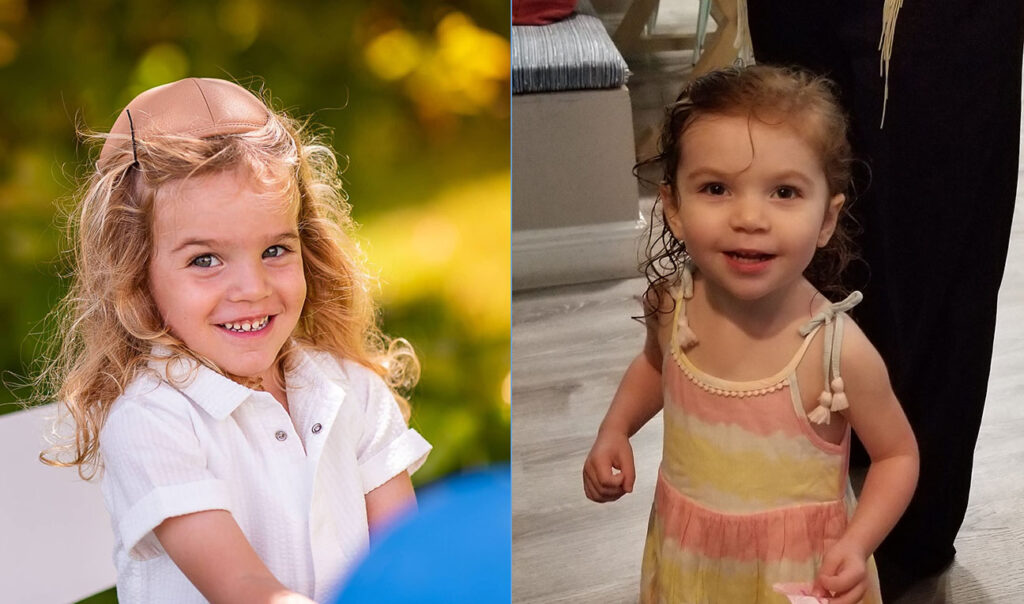
It started like any other day during the summer of 2022 in Boca Raton, Florida. Sara Dorsky and her husband came home from work and let their three kids go outside to play in the pool while they watched them.
“The next thing I know, I turned around and said, ‘Where is Dina?’ I heard the front door open, so I thought she ran outside,” recalled Dorsky. “We couldn’t find her for a minute or so, and then my husband found her in the pool. He called 911, and we went to our neighbor — a very close friend of mine who is a nurse practitioner.”
The nurse worked on two-year-old Dina until the medics arrived and rushed her to the hospital. The doctors tried to revive the little girl, but it was too late.
At the time, Dorsky was in her first trimester of pregnancy, expecting her fourth child. As an Orthodox woman she initially felt angry at God, and then she started talking with him.
“I was mad and I still am,” she said.“And at the same time, I was just confused. But when you are in the depth of darkness – and you hear it a lot since Oct. 7 –you feel more connected to God. I told him, please help me through this and the minute I opened myself to God, he did, and he had given me strength to push through.”
What also helped Dorsky was the community that surrounded her throughout her ordeal. Three of her closest friends stayed with her at the hospital, and her house was full of people all the time. Family flew in from across the U.S. and Israel. Her friends created a WhatsApp group to ensure that there would always be someone there for them. The kosher supermarket supplied food and gifts. It was an outpouring of support and love that anyone could ask for in times like this.
Then, one day while visiting her daughter’s grave, she met another grieving mother, Nechama Tauber. Nechama’s three-year-old son, Sholom, had tragically died just a few months after Dina. He had been left in a car after his father dropped off the older children at summer camp. Sholom was the eighth of nine children.
“That day my husband drove the kids to camp, and there was a little change in routine and schedule,” said Tauber. “The kids were so happy that they had gotten to camp a little earlier that day and went to play. My husband dropped them off and went to park his car when he got a call from his office upstairs. He works in the IT department of the school and they needed something urgent. He said, ‘I’ll take care of it,’ and got out of the car. Sholom was still buckled into his car seat in the back.”
At the end of the workday, Menachem Tauber went to pick up his son from his classroom. He expected him to run up happily as he always did, but to his surprise, the teacher said that Sholom hadn’t come to school that day.
“He called me frantically and thought that maybe I had picked him up,” Nechama said. “When I said I hadn’t, he ran to the car and found him there, but it was too late.”
Even now, three years later, it’s still difficult for Nechama to retell the story. At first, there was a lot of anger and confusion over why it happened, but the anger wasn’t directed at her husband; it was directed at God for “allowing” it to happen.
“I couldn’t blame my husband. I love him too much, and I know it could have been me. I felt deeply that this is God’s fault, His plan. I felt like He carried something for me, like God had said that Sholom had to die this way and it didn’t happen to me because I wouldn’t have been able to withstand it.”
A few months later, on Rosh Hashanah, Tauber wasn’t able to pray — she felt very betrayed by God. He had given her this precious little boy and then took him away. Ten days later, on Yom Kippur, she took another approach and began praying, perhaps seeking answers as to why this tragedy had happened.
“I cried from the depth of my heart, and a lightbulb went on, and I said to God, ‘I believe You allowed this to happen, and now You are going to heal me.’”
The healing process is ongoing, and the pain of losing a child will never go away. But out of these unimaginable losses, something beautiful emerged — the two women who met at the cemetery decided to collaborate to help prevent similar heartache for other families.
It started with a phone call from Rabbi Zvi Boyarsky, who asked the Taubers if they would share their son’s story to channel their grief and create a movement that could prevent other families from experiencing similar tragedies.
“In the wake of our story, my husband Menachem and I have learned something tragic: hot car deaths are not rare occurrences. They’re happening right here in our communities — in the U.S. and in Israel,” she said. “People are getting distracted. The biggest thing parents can do is switch that mindset. Don’t close your eyes and say, ‘I love my kids so much, it won’t happen to me.’ Just be aware that these things do happen in our community because our minds can fail us.”
That’s how Team Protect began — with Tauber, Dorsky and a dedicated team of people who understood that these tragedies can be preventable through technology and awareness. They have partnered with emergency response organizations, schools, and communities to create comprehensive safety networks.
Car device which gives reminders to parents to check the back seat: Clever Elly
On their website, parents can find simple gadgets designed to prevent future tragedies. One is the CleverElly, a simple yet powerful device from another nonprofit that plays a verbal reminder each time a car’s engine shuts off, helping drivers develop the habit of checking the back seat before exiting. The best part: the reminders rotate among 10 different voices and phrases, keeping the warnings fresh and ensuring parents remain attentive. Another is Mylo, by Coral Smart Pool, an Israeli company that has developed one of the most advanced anti-drowning technologies on the market. This initiative has allowed dozens of families to access advanced safety equipment at a heavily reduced price, promoting safer environments for children.
Dorsky emphasized the importance of education and preventive measures. “There are many organizations that provide guidance on securing your pool, installing pool alarms, and advocating for swimming lessons,” she said. She also made sure her baby, born after the tragedy, was enrolled in swimming lessons.
Even though all her children are good swimmers, she and her husband made sure to fence the pool and use various safety devices to alert them if anything went wrong.
“Drowning is the leading cause of death for children under five,” she said. “It can happen quickly and quietly, even with adults nearby. I have a friend who told me she was holding her daughter’s hand as they were getting into the pool, and her daughter still had to be pulled out.”
Tauber said that Sholom continues to inspire change. He is doing so through his parents and their “59 Seconds for Sholom” campaign – a global movement that can save countless lives. “His legacy guides us to slow down, to stay present, to cherish each moment and to consciously make space for peace in our lives,” said his loving mother.
Several Los Angeles–area rabbis have joined the family of Raphael Lemkin, the Polish-Jewish jurist who coined the term “genocide,” in urging Pennsylvania officials to review how the Lemkin name is being used by a U.S. nonprofit the family says turns his legacy against Israel.
Rabbi Marvin Hier, founder of the Simon Wiesenthal Center, together with local rabbis Yitzchak Lasry and Tal Perez, signed letters asking Gov. Josh Shapiro (D-Pa.) and state officials to act. Their message: using the Lemkin name to accuse Israel of genocide misrepresents the history and moral purpose behind his life’s work.
“Raphael Lemkin’s name was meant to protect the Jewish people, not to be used against them,” said Joseph Lemkin, a New Jersey attorney, partner at Stark & Stark, and founder of the Jewish Bar Association of New Jersey. “When we see his legacy turned upside down, it feels personal, especially after Oct. 7.”
The letters follow a family complaint filed in Pennsylvania on Sept. 29 asking the state to review public uses and registrations of the Lemkin name by the organization. As one example, the family points to an “Active Genocide Alert” the group posted on Oct. 13, 2023, days after the Hamas attack, which the family says misstates Lemkin’s intent.
Lemkin said the response has been broad and local. “We’re hearing from survivors’ families, community members and rabbis here in Los Angeles,” he told the Jewish Journal. “It’s moving to see how many people want to keep the Lemkin name sacred, above politics.”
He added thanks to Rabbi Hier and the LA rabbinic community. “Rabbi Hier built a life’s work around Holocaust memory and fighting hate,” Lemkin said. “To have his voice, and the voices of other LA rabbis, stand with us matters a great deal.”
The organization at the center of the dispute denied the allegations.
Maimon Miller served as a Rabbi at the Edmond J. Safra Synagogue in Manhattan and at Aish San Diego. He is currently a transformational life coach and owner of an immigration law firm.
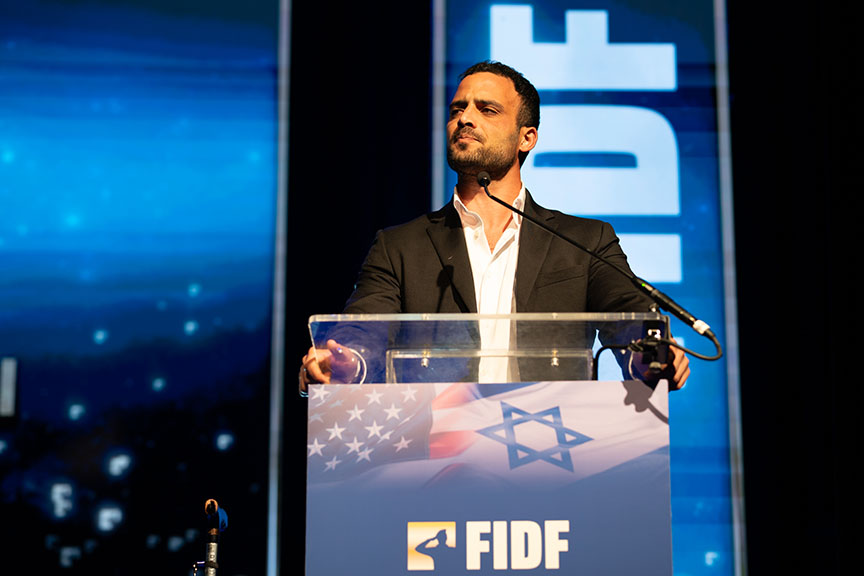
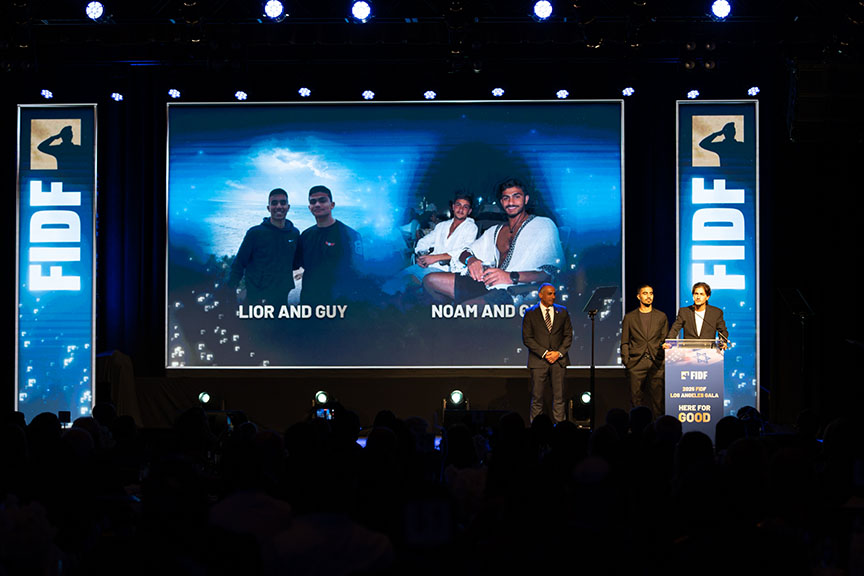
Award-winning journalist Erin Nolan hosted the Friends of the Israel Defense Force (FIDF) Gala, held at the Fairmont Plaza Hotel in Century City. Nolan previously hosted a weekly national affairs program, “Erin,” on Sky News Australia. After Oct. 7, she became outspoken in her support of Israel, which led to death threats and relentless attacks on social media.
Standing on stage before an audience of FIDF donors, Nolan shared that her father, a soldier, taught her to stand up for what is right, no matter what the obstacles are. “If you had told me that after condemning what happened in Israel on Oct. 7 it would be controversial, I would have said no way — but that’s exactly what happened.” In December 2024, her support for Israel cost Nolan her job at Sky News. Days later, she traveled to Israel where she visited the Nova site and met with families of hostages and survivors.
Even though she already knew she was standing with the right side, once Nolan was there, she understood the magnitude of the events. It’s one thing hearing the numbers, 251 hostages and over 30,000 wounded and another to hear first-hand what it means to be a hostage or a wounded soldier or civilian. Some of the victims of the Oct. 7 attack attended the gala, including two former hostages, a bereaved father, and a wounded Israeli soldier who admitted he could stand and speak only with the aid of heavy medication.
Barak Deri. Photographer: Liron Liber
The impact of the war on Captain Barak Deri will last his entire life. He sustained severe injuries after a Hamas grenade was thrown at him in Gaza, and his chest was riddled with metal shrapnel. Since December 2023, when he was wounded, he has spent a year in the hospital, undergone dozens of surgeries and endured countless hours of physical therapy. Yet, nearly two years later, his life still revolves around managing constant pain, with no hope of a full recovery.
Still, Deri does not feel sorry for himself, nor does he blame anyone. This is not his first visit to the U.S.; he has spoken before at various forums, synagogues, schools and universities. Speaking with The Journal, he admitted that sharing his story doesn’t necessarily make him feel better, but he sees it as his mission. He wants people to know what happened — and he sees the impact it has on them.
Standing with the help of his walking stick, Deri recounted the events of Oct. 7. That morning, his three brothers were at the Nova music festival. After hearing the news, he left his home in Tel Aviv and headed south. He faced a difficult decision: join his unit and head to Kibbutz Be’eri, which was under attack, or go and search for his brothers. He chose to join his unit, hoping his brothers would survive.
Once his unit arrived in Be’eri, they fought hundreds of terrorists, moving from house to house to save as many families as possible, sustaining heavy losses in the process. One of Deri’s closest friends died in his arms, and he witnessed horrific scenes of death and destruction. Later, he was diagnosed with PTSD. A few months after that, while joining a rescue operation in Gaza to free hostages — including Americans Judith and Natalie Raanan — he was severely injured.
Before Oct. 7, Deri had never fired a weapon. During his military service from 2011 to 2017, he served in intelligence within an elite unit. After Hamas’ attack, he was transformed into a combat soldier.
During a battle in Gaza, as Hamas terrorists closed in on him and shot at close range, Deri contemplated taking his own life rather than being captured. Somehow, he managed to throw a grenade at them and survived. Despite his injuries and constant pain, Deri says he remains optimistic about the future and about peace in the Middle East.
Bereaved father Dedi Simhi. Photographer: Liron Liber
A bereaved father, Brig. Gen. (Res.) Dedi Simchi — former Fire and Rescue Commissioner of Israel — spoke about his son, Guy, who was only 20 when he was killed on Oct. 7. Guy was a paratrooper, but that day he was on a break and attending the Nova festival. He showed extraordinary courage, saving the lives of his friends by getting them into a protected shelter in a home at Kibbutz Re’im. Though unarmed, he refused to hide and insisted on defending the house alongside his friend, a member of the elite Maglan Unit. Two terrorists who entered the home were killed by Guy and his friend, but not before one threw a grenade into the small living room where they were sitting.
Two of the friends Guy saved attended the gala and spoke of the incredible young man who gave his life for others. Simchi recalled how he tried to reach his son by phone but, when there was no answer, he put on his uniform and drove to Kibbutz Re’im, arriving at 2 a.m.
“I told the soldier stationed at the entrance to Kibbutz Re’im that my son was lying there, dead,” Simchi said. “They recovered him, I hugged him, and took him to Rammalah, where they were bringing those who were killed.”
“My son, I love you and miss you,” Simchi said. “We will never forget and never forgive. Yet, out of this, we will rise and change the Middle East. Lions like those you’ve seen tonight — and like my son, who fought with his bare hands to save his friends — are the true and secret weapon of our nation.”
Among the guests were Sasha Troufanov, 29, and Sapir Cohen, 31, who were kidnapped by Hamas on Oct. 7 from Kibbutz Nir Oz, where they had gone to visit Sasha’s family. That morning, terrorists stormed the home, murdering Sasha’s father, Vitaly, and abducting Sasha, his mother, grandmother and Sapir.
The two were separated in captivity. Sapir was released after 55 days, while Sasha remained in captivity for 498 days. Upon his release in January of this year, Sasha learned that his father had been murdered on Oct. 7. His mother and grandmother were freed after 52 days.
Sasha, who sustained injuries to both legs, now uses crutches and continues to cope with pain. It was later revealed that he had been held by the Islamic Jihad and kept alone, away from the other hostages.
During the gala, it was announced that the couple had recently become engaged — and the room erupted in cheers. After everything they had endured, their love, courage and hope stood as a powerful reminder that even in the face of unimaginable darkness, the Israeli spirit prevails.
Simon Etehad raises money at the Gala. Photographer: Liron Liber
FIDF President Simon Etehad thanked the guests, including Consul General Israel Bachar, Beverly Hills Mayor Sharona Nazarian, and U.S. Representative Brad Sherman (D-Sherman Oaks).
“For nearly 45 years FIDF has been the trusted partner, delivering any program service that the IDF requested,” Etehad said. “We have touched the lives of nearly 500,000 soldiers and their family members. While the brave soldiers are fighting for Israel’s right to exist, we as a community, have the moral, financial, and political responsibility — as Jews living outside of Israel — to support and advocate for Israel.”
The gala raised over $9 million, including donations of $1 million from Leo David and $4 million from Claire and Dennis Singer.
Our friend Esther is blessed with a busy life (a lot of chesed and volunteering) and a home filled with family and lots of friends. She is the queen of setting up beautiful, bountiful buffets, effortlessly feeding a ton of people.
I laugh whenever I think of her famous dish “Shut Up and Eat Chicken” and her menu options “Take it or leave it!”
Honestly, when it comes to chicken, I’ll shut up and take it.
At my home, chicken is on the menu every Friday night. I can serve soup, salads, fish but a roasted chicken is always the star of the meal. I know it will get eaten. It’s easy to prepare, and endlessly adaptable to different flavors, depending on my mood.
My mother always served a simple, comforting dish of roasted chicken with potatoes. She flavored the chicken with saffron and white wine and that aromatic smell felt like the essence of Shabbat.
I was always served the chicken breast and I would take a few bites. But I really loved the potatoes and I especially loved dipping my challah in the rich, savory caramelized juices.
For this recipe, I whisk together Dijon mustard, white wine, olive oil, salt and lemon juice for the marinade. In a large roasting pan, I layer thinly sliced onions and heirloom carrots, place the chicken pieces on top, and tuck in slices of lemon and orange, I add a whole head of garlic and slice the top off so it gets golden and soft. I pour the marinade over everything and add a few sprigs of fresh thyme.
The chicken goes into a hot oven at 425°F for 20 minutes which gives it a marvelous golden crisp skin. Then I lower the heat to 350°F and roast the covered chicken for an hour. For the last 15 minutes, I uncover the chicken, so the skin can finish browning.
When the chicken comes out of the oven, the smell is incredible. The citrus has caramelized, the onions and carrots are transformed into irresistibly sweet and savory morsels.I tuck the croutons all around and under the chicken, so the juices get soaked up and the croutons are golden and just a little chewy from the pan juices. It’s not a complicated recipe simple, familiar, and it always works. The citrus gives it a brightness that keeps it from feeling heavy, and the croutons make it just a little more special.
—Rachel
Have you seen the cartoon where the turkey is upset that it’s Thanksgiving soon?
His chicken buddy retorts “Have you heard of Shabbos?”
Chicken is the classic dish of Shabbat. But this chicken recipe is special enough to serve on Thanksgiving, if you don’t feel like going the turkey route.
All the magic is in the stuffing. The combination of soft fluffy bread doused in the umami flavor of roasted chicken juices is just irresistible.
—Sharon
Chicken and Marinade
8-10 bone-in chicken pieces
1 large onion, thinly sliced
6-8 small heirloom carrots
1 lemon, thinly sliced
1 orange, thinly sliced
1 whole head of garlic
3–4 sprigs fresh thyme
Salt
Marinade:
3 Tbsp Dijon mustard
1 cup dry white wine
1/2 cup olive oil
Juice of 1 large lemon
1 tsp salt
Pepper, to taste
Croutons:
1 baguette, sliced into thick rounds
2 tablespoons extra virgin olive oil
1 tablespoon paprika
1 tsp garlic powder
1 tsp salt
Marinate & Roast:
Preheat oven to 450°F.
Whisk together the Dijon mustard, white wine, olive oil, lemon juice and salt.
In a large roasting pan, scatter sliced onions and carrots across the bottom.
Arrange chicken pieces on top and tuck in lemon and orange slices in between the chicken, slice the top of the head of garlic off and add to center of the pan.
Pour the marinade over everything and add sprigs of thyme.
Roast uncovered for 20 minutes, then cover with foil, reduce heat to 350°F, and bake for one hour.
Uncover and roast for another 15 minutes, until golden and caramelized.
Make the Croutons:
Toss baguette slices with olive oil, paprika, garlic powder, and salt.
Bake at 400°F for about 10-15 minutes, until golden.
Let cool completely so they stay crisp.
Sharon Gomperts and Rachel Emquies Sheff have been friends since high school. The Sephardic Spice Girls project has grown from their collaboration on events for the Sephardic Educational Center in Jerusalem. Follow them on Instagram @sephardicspicegirls and on Facebook at Sephardic Spice SEC Food. Website sephardicspicegirls.com/full-recipes.
One verse, five voices. Edited by Nina Litvak and Salvador Litvak, the Accidental Talmudist
And the life of Sarah wasone hundred years and twenty years and seven years; [these were] the years of the life of Sarah.
– Gen. 23:1
Gilla Nissan
Teacher and Author of “Meditations with the Hebrew Letters – A Guide for the Modern Seeker” thehebrewletter.com
Up to the Mabul, or Flood, people in our dear Tanach, the true name of our Bible, lived even up to 969 years, the age of Methuselah; 950 years like Noach and 930 years, the age of Adam when he passed away. After the Mabul, as we were permitted to eat meat, people lived up to 120 years. Moses, whose age was 120 when God simply took him by Himself, reached the divine limit of human life. Elijah, who ascended to Heaven with the Chariot of Fire, has no recorded age.
And here is our Mother Sarah, guardian of the Jewish people, known for her great physical beauty, at 20 she was as beautiful as at seven, pure and natural, and for her clear vision to separate Isaac from his brother Ishmael, guiding each to fulfill the mission of their soul. She passed away at the age of 127.
The text mentions her age twice. The Torah repeats and divides her years to reveal that Sarah’s outer beauty, inner purity, and spiritual integrity were united through every stage of her life. Kabbalistically, her 127 years mirror the three levels of soul: Nefesh, Ruach, and Neshama — body, heart, and spirit in complete harmony. Sarah’s life reveals the balance of form and essence, the feminine power of divine presence within time itself. She lived each year as fully as if it contained all her years.
Gavriel Sanders
Spokesman, Be A Mensch Foundation
A Lite Life or A Life of Light?
Why divide Sarah’s age into three parts — 100, 20, and seven? Rashi, quoting Midrash, says each number represents a stage of spiritual wholeness: at 100 she was as free of sin as at 20, and at 20 as beautiful as at seven. But another Midrash gives us an even deeper spark: as long as Sarah lived, a lamp burned from one Sabbath to the next, blessing hovered over her dough, and a cloud of divine presence rested on her tent. When she died, those miracles ceased; when Rivka entered the tent, they returned.
Here’s the “wow”: the Torah’s arithmetic isn’t about counting years — it’s about counting light. Sarah’s life radiated blessing so tangible that its absence could be seen. The verse isn’t a eulogy; it’s an equation — years of life equal years of light.
Our goal is not merely to live long, but to live illuminated. The Midrash challenges us to ask: does my presence add warmth and clarity to the world? Do I leave a glow that lasts from one Shabbat to the next? Sarah’s tent becomes a metaphor for every home, classroom and heart that chooses kindness over cynicism and faith over fear. To live like Sarah is to let divine light linger long after we’ve moved on.
Rabbi Nicole Guzik
Sinai Temple
The Kedushat Levi offers a beautiful glossing to this verse. He says, “Expressed somewhat differently, the Torah states that it was Sarah, who with her good deeds gave ‘life’ to her years.” Meaning, the extraneous phrasing following her age is confusing. Why does the Torah add these details? The Hasidic master reasons the additions elicit a daily choice: to spend our time living or spend our time dying.
Which kind of person are you? Is your day filled with opportunities or detriments? Do you look forward to the unfolding of your schedule or count down the seconds until bedtime arrives? Do you exhale sighs of relief or disdain? In other words, are you spending time living or dying?
Dr. David A. Jobes teaches a class on “The Psychology of Living.” He explains that within the first day of registration, the class was full. Topics that were once perceived as fluffy are now major conversations: how to cultivate hope and resilience, defining spirituality, the vital nature of relationships and intentionality. The professor was surprised by the engagement of the students and their desires to seek answers to the age-old question: how does one live a meaningful, purposeful life?
The Torah is not always a book of answers. The Torah is often a book of questions. Prompts to help us ask the necessary questions so that we are not merely existing. How blessed we are that our tradition inspires necessary questions that propel us to choose life, every single day.
Reading this verse made me wonder why the Torah speaks in such a strange way. Why not just say Sarah lived 127 years? Why divide her life into three parts?
After thinking about it some more, I realized that maybe no single number can capture a person’s life. Breaking it up into 100, 20, and seven reminds us that every stage matters on its own.
I think about that a lot because I never really felt like I grew up in one place. My family is from the Soviet Union, I was born in Jerusalem, moved to California at 12, and I am still figuring out where I belong. Am I Russian? Israeli? American? Just a Jew? Sometimes it feels like I have already lived a few different lives.
But maybe that is the point.
Just like Sarah’s years were all part of one life, all my versions of home, faith and identity are part of mine.
The Torah is not just counting Sarah’s years. It is honoring them. Maybe that is what it means to live fully: to let every chapter of our life count.
Rebbetzin Miriam Yerushalmi
CEO, SANE; Counselor; Author, Reaching New Heights series
During an interrogation by the Russian police, Rebbe Yosef Yitzchak Schneersohn announced, “Nothing and no one can make me deviate from my principles!” One of the officers pointed his gun at the Rebbe, saying, “This toy does away with many principles, and opens many mouths.” “That toy,” the Rebbe replied, “impresses cowards who have only one world and many gods, who are afraid to lose this solitary world. But as a Jew, I have only one G-d and two worlds, and this toy does not frighten me.” Nothing can break us, nothing can shake us, because we have our One G-d and two worlds.
“Chayei Sarah“ can be read as plural, “The Lives of Sarah.“ The Parsha talks about Sarah’s death, but it is called “Sarah’s Life (Lives),“ because even in death, she was transitioning to a new life, the truest life, free of the shackles of the body, free of the worldly challenges. Sarah was the first Jew to die; with her supreme level of faith and strength she paved the way, teaching us not to fear what lies ahead. We certainly needed that faith and strength to face the bittersweet double challenge of only some of the hostages returning alive.
“Things” are not truly over just because they are over in this world. For those whose lives were cut short, we, the living, have a responsibility to live our lives meaningfully, as Sarah did, with each day accounted for — a form of resurrecting the dead (Techiyas HaMeisim).
In pedagogy, scaffolding is the process of breaking a larger, more complex idea or task into smaller, manageable steps. For example, if I wanted to teach symbolism, I would scaffold the lesson by first asking students to identify concrete objects in a room. From there, I would guide them to consider the emotional or thematic associations those objects evoke, and only then introduce the concept of symbolism as the use of tangible objects to represent abstract ideas. Through apophasis, we learn what something is by defining what it is not, and this principle helps clarify whether students have truly grasped the concept. I would know that students have met the learning objective when, upon being shown a painting by René Magritte, they are able to correctly determine that it does not belong to either the realist or impressionist art movements.
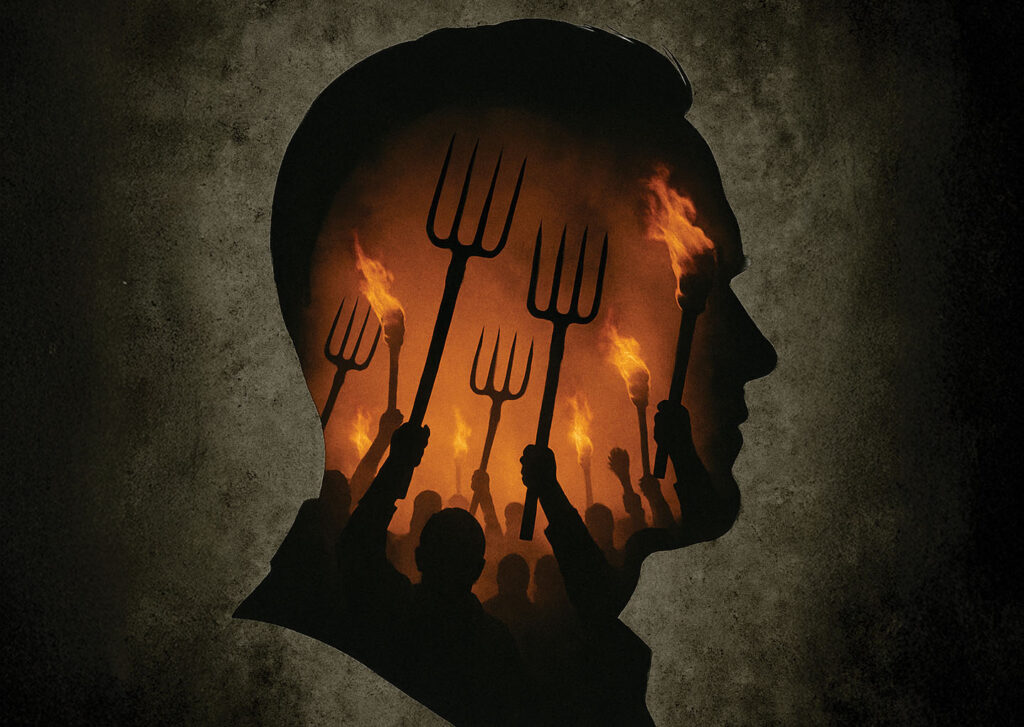
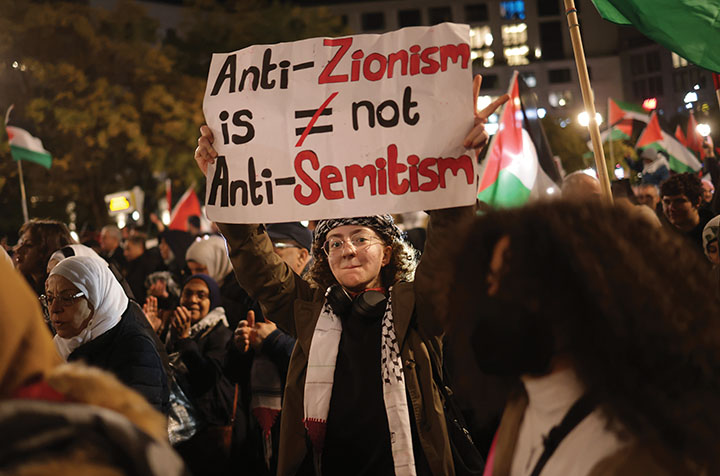
When we apply this scaffolding model to anti-Zionism, a troubling picture emerges: most people do not know how to understand it. At best, they say, “anti-Zionism is antisemitism,” and at worst, “anti-Zionism should not be confused with hating Jews.” This confusion persists because Jew-hatred was never properly scaffolded. Instead, we rely on an all-purpose definition of antisemitism as “a certain perception of Jews, which may be expressed as hatred toward Jews.” This flattening of a complex and adaptive hatred has obscured the latest form of Jew-hatred: anti-Zionism.
Sean Gallup/Getty Images
But more to the point: how have we been teaching about antisemitism? From my own experience in Jewish day schools, I was taught that antisemitism is primarily about intolerance and scapegoating. With respect to the Holocaust, the culmination of the antisemitism era, we were taught an equally flattened narrative: Jews were othered by Nazis, i.e. white supremacists. In the 1990s, Holocaust survivors came to speak to us, and we listened with tears. Their stories gripped us, and we vowed “never again.” Yet, having studied Holocaust survivor testimony as an adult, a troubling pattern emerges. This is not the fault of the survivors themselves: their stories were about survival, not about the mechanisms that led to their dehumanization.
My grandfather was a Holocaust survivor. He could not help but tell us how his little brother was burned alive in a synagogue in Baranovichi, or how his older brother was shot during morning roll call in the ghetto. He described his escape by bicycle into Soviet territory. These were the stories survivors told: stories of how they endured. What is often missing from these narratives, and what our teachers did not supplement, was the role of antisemitic libels in marking Jews for extermination. Nor were we taught that prior to the Holocaust, and even before Wilhelm Marr coined the term “anti-Semitism,” there existed an earlier form of Jew-hatred: anti-Judaism. Most critically, we were not taught that Jew-hatred is uniquely complex because it mutates.
In sum, the way we have taught antisemitism has obscured three essential components of Jew-hatred:
1. Jew-hatred mutates
2. Anti-Jewish libels are the delivery mechanisms that spreads each new strain
3. Jew-hatred is a virtuous hatred: it constructs Jews as villains to justify itself
Significantly, when anti-Zionism arrived in the West, more specifically, on American campuses in the early 2000s, Jews and Jewish professionals were unsure how to understand it. Many were misled into believing that anti-Zionism was simply political criticism of Israeli state policy. At the same time, among those Jews who did recognize that anti-Zionism was a rearticulation of antisemitism, a similarly troubling pattern emerged. Believing that anti-Zionism was merely an ideological opposition to Zionism, pro-Israel advocacy organizations poured millions into initiatives aimed at defining and promoting Zionism, assuming that Zionism was the direct opposite of anti-Zionism.
But does anti-Zionism need Zionism in order to operate? The answer is no. Anti-Zionism is not actually concerned with whether Jews can or should self-determine politically, nor is it interested in the relationship Jews have with Israel. Anti-Zionism is a project centered on producing villains. In this, it follows its predecessors: antisemitism and anti-Judaism. Antisemites were never concerned with the authenticity of Jewish identity, practice, or behavior; they sought to construct “the Jew” as a villain. Similarly, anti-Judaists such as Martin Luther or St. John Chrystosom were not interested in Jewish liturgy; they were invested in casting Jews as anti-Christian enemies. Anti-Zionism repeats this mechanism, simply substituting “Zionist” for “Jew,” while inheriting the same foundational hatred.
Critically, antizionist apologists such as Mira Sucharev argue that anti-Zionism is not a form of Jew-hatred because they define it as opposition to Zionism, just as one might (incorrectly) assume antisemitism stands in opposition to “semitism,” which, of course, is absurd. By framing anti-Zionism as a political stance against Jewish self-determination, today’s antizionists fail to recognize that anti-Zionism was deliberately constructed to appear as legitimate political criticism while functioning as a hate movement.
Failing to recognize that anti-Zionism, whose Soviet and Nazi genealogy reveals that it has nothing to do with Jews and their right to self-determine, is fundamentally a project of constructing villains, they also overlook a crucial point: Israel does not need to exist for the anti-Zionist to exist. The large-scale violent antizionist pogroms, such as the 1920 Nebi Musa riots in British Mandate Palestine, the 1921 Jaffa riots, the 1929 Hebron massacre, the 1934 pogrom in Algeria, the 1941 Farhud in Iraq, and the 1945 Tripoli pogrom in Lybia all occurred without a sovereign Jewish state and, therefore, without any self-determined Jewish national entity. Further still, even if their qualm is with Zionism, Zionism itself does not stipulate state action, but only that a Jewish state should exist.
Israel does not need to exist for the anti-Zionist to exist.
Because anti-Zionism is not actually an opposition to Jewish national self-determination, and because it does not require the existence of Israel to oppose, we must ask: what is it?
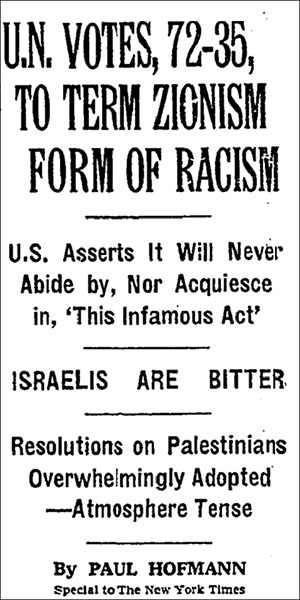
Clipping from cover of the New York Times, Nov. 11, 1975
Anti-Zionism is a structural form of Jew-hatred, one that reproduces the Jew as villain through the delivery mechanism of antizionist libels. Consider the slogan, “Zionism is racism” formulated by Yevgeny Primakov, a leading Soviet Middle East strategist and KGB analyst. He was one of the primary architects of the ideological frame that recast Zionism as a form of racial imperialism. Just a few years later, “Zionism is racism” was institutionalized at the United Nation via UN resolution 3379. Critically, the Soviets defined Zionism as racism in order to construct a villain much like St. John Chrysostom, in the fourth century, wrote a series of homilies in which “Jews themselves are demons.” Primakov and St. John Chrysostom are separated by 1,500 years but because Jew-hatred is structural, those who understand that Jew-hatred is forged around the construction of villains, know that “Zionism is racism” is the latest version of thousand-old ritual of casting Jews in the role of villain.
Those who recognize that Jew-hatred operates through this mechanism understand that “Zionism is racism” is simply the latest iteration of an ancient ritual of casting Jews as the enemy. Many struggle to perceive this structural continuity because the language now appears modern. But it is not. It is demonology: Today’s demons are named not as “Christ-killers,” or “race-polluters,” but “racists,” “colonizers,” “genocide-wagers,” and “nationalists.” Here it is useful to consider how antisemitism is commonly defined: “a certain perception of Jews, which may be expressed as hatred toward Jews.” This indefinite definition obscures the essential feature shared by all anti-Jewish movements: the construction of Jews as villains.
In the era of anti-Judaism, “Judaism” served as the symbolic representation of everything a society believed to be wrong, threatening, corrupting, or dangerous to Christianity. In the era of antisemitism, the construction of “the Jew” followed the same logic: a conceptual figure used to explain what a society perceived as threatening, corrupting, or dangerous to the purity of race.
Anti-Zionism continues this pattern. It is a worldview that uses the “Jewish state” or “Zionism” as the symbolic figure of what is believed to be wrong, threatening, corrupting, or dangerous to post-colonial doctrine. Once we understand that anti-Zionism is the third variant of Jew-hatred, and that it has very little to do with Zionism itself, we will stop pouring millions into programs aimed at defining or defending Zionism. That is not the answer to anti-Zionism. Just as the answer to antisemitism was never to prove how good Jews are, the solution was to expose antisemitism as a hate movement: to show that the race-polluter libel and the swastika are hate symbols directed at Jews.
Once we understand that anti-Zionism is the third variant of Jew-hatred, and that it has very little to do with Zionism itself, we will stop pouring millions into programs aimed at defining or defending Zionism.
So too, the answer to anti-Zionism is to expose the libels and symbols unique to this latest variant. Yes, this means letting go of the frameworks of the antisemitism era: letting go of Holocaust education as the sole paradigm, letting go of caricatures of Jews with big noses as the central visual symbol, letting go of the assumption that we still live in the time of antisemitism. We have already done effective work exposing antisemitism: even with the current surge of swastikas and “Hitler was right” graffiti, society recognizes antisemitism because it has been inoculated against that second variant of Jew-hatred.
What we now urgently need is education on the latest strain: anti-Zionism. And that begins with teaching, clearly and systematically, that Jew-hatred mutates; that each mutation is delivered through its own libels; and that the purpose of these libels is always to construct the Jew as the villain of the moral imagination. Only once this scaffolding is restored can we expose anti-Zionism not as political critique, but as the third variant of an ancient and adaptive hatred.
Crucially, this means not responding to anti-Zionism by teaching more about Zionism. For years, well-intentioned Jewish institutions responded to antizionist accusations by trying to define Zionism more clearly: “Zionism means Jewish self-determination,” “Zionism is the liberation movement of the Jewish people,” “Zionism is love of the land and the Jewish story.” These claims are not wrong; they are simply irrelevant to anti-Zionism. Anti-Zionism does not oppose Zionism’s meaning. It does not care what Zionism actually is. Anti-Zionism requires only that “Zionist” signify the villain. To counter anti-Zionism by explaining Zionism is therefore to fight a symbolic war on the wrong battlefield. It is to refute an accusation that was never based in misunderstanding to begin with.
Thus, the task is not to defend Zionism. The task is to expose the libels that make the “Zionist” into a villain. We must show that slogans like “Zionism is racism,” “Israel is genocide,” or “Zionists control the media” are not political critiques, but delivery systems of a familiar and ancient hatred, updated in vocabulary and moral justification, but unchanged in structure. To try to counter anti-Zionism by proving Zionism is moral is to repeat the historical mistake of trying to counter antisemitism by proving Jews are moral. That was never the point. The Jew-hater does not hate because of what Jews are or do. The hatred defines the Jew, not the other way around. The work before us is therefore not to rehabilitate Zionism, but to teach how the villain is constructed, and to show that this construction is the organizing logic of Jew-hatred in every era.
Naya Lekht is currently the Education Editor for White Rose Magazine and a Research Fellow for the Institute for Institute for the Study of Global Antisemitism and Policy.