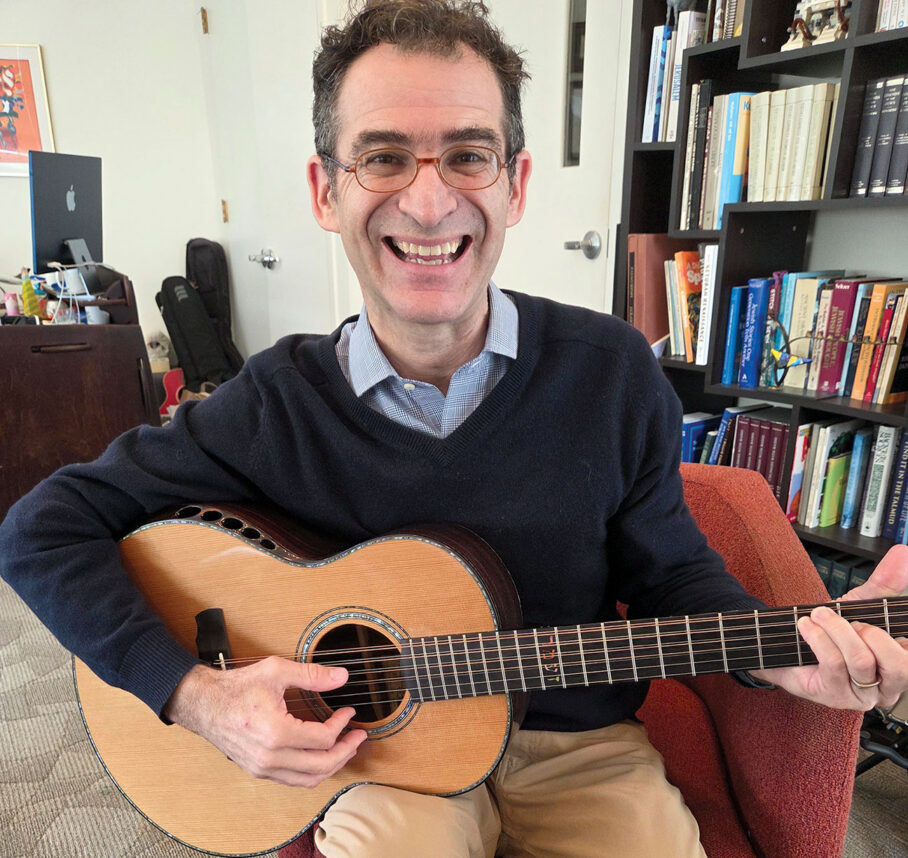
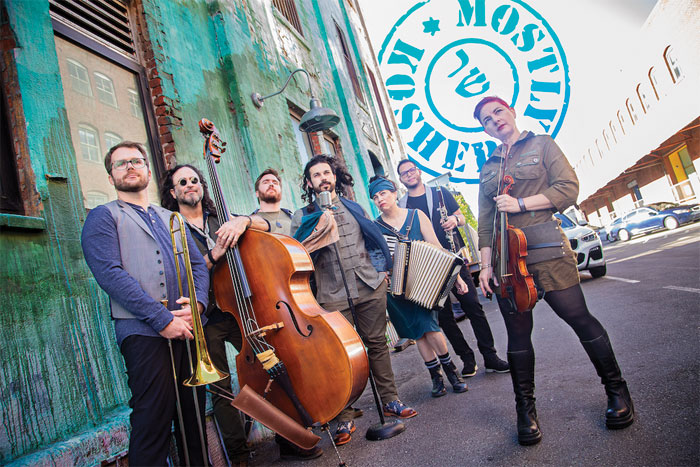
In 2010, Leeav Sofer was in university studying clarinet and voice. To help pay for his education, he’d play piano at weddings and private parties. After one wedding, Sofer was talking to an elderly lady, who said, “You’re Jewish, and a clarinet player? You must play klezmer!”
While Sofer was familiar with Jewish music he’d heard in synagogue, he had never played klezmer in his life.
“So I answered, ‘Of course I play klezmer!’” said Sofer. “She responded, ‘So you must have a Klezmer band?’ [I said] ‘Of course I have a klezmer band!’”
The woman followed by saying she was the president of the local synagogue’s sisterhood and they had a huge gala every year. She wanted Sofer’s “band” to headline the concert.
“I responded in a sheepish voice ‘Greaaaaaat…’” Sofer said. He quickly went into action, calling all his Jewish university colleagues and asking if they wanted to be in his klezmer band. “Soon I ran out of Jewish colleagues so I started calling the non-Jews: ‘Want to be in my klezmer band? What’s klezmer? We’ll find out together!’”
Sofer got together enough members, and they researched and treated the concert as if they were preparing for a recital. From that performance came five more, then five more after that.
“Soon enough we needed a name, and since some of us were global-music-loving non-Jews, we decided on Mostly Kosher.” – Leeav Sofer
“Soon enough we needed a name, and since some of us were global-music-loving non-Jews, we decided on Mostly Kosher,” said Sofer.
Twelve years, multiple tour dates, a groundbreaking appearance at Disney’s California Adventure Park and a recent concert at Skirball Cultural Center later, and the critically acclaimed band has released their second album, “This World is Yours.”
The band kicked off the release with a party at the Skirball on February 24. The album contains traditional klezmer and modern rock songs, including the title song, which is an original lyrical and musical response to the Yiddish Hanukkah lullaby “Barukh Ateh,” written in 1921 by Solomon Golub and Abraham Reisen.
The tracks, which respond to various sources like the biblical Songs of Solomon and Ladino folk songs, include messages about social justice, mutual understanding and unbridled joy. “The World Is Yours” was inspired by the rock albums “The Rise and Fall of Ziggy Stardust and the Spiders From Mars” by David Bowie and “Hazards of Love” by the Decemberists.
Sofer, who is Israeli but grew up in California, learned the traditional Jewish songs as a kid; his mother was a cantor at Pasadena Jewish Temple and Center as well as Long Beach’s Temple Beth Shalom.
“I spent so much of my childhood traveling back and forth to Israel, as well as hearing Israeli folk music around the house from my dad,” he said. “Coincidentally, the Ashkenazi yiddishkeit of klezmer music was not a big part of my childhood.”
“The World is Yours” came together over a four-year period, including the 20 months during lockdown in LA. Violinist and founding band member Janice Mautner Markham said that the pandemic has been a challenge for the band.
“We had to deal with canceled performances and tours, as well as strange isolation from our friends and collaborators,” she said. “But, we tried to use the time as creatively as possible.”
One of the aims that Mostly Kosher has is to bring together Jews and non-Jews. For instance, in 2016, they became the first Jewish music ensemble to join the Festival of Holidays at Disney’s California Adventure Park.
“With Disney being such a huge national and international tourist attraction, we had the honor to share, and in many cases, be the first impression of Judaism for thousands of tourists,” Sofer said. “It’s a true honor representing our culture and faith at the parks.”
With antisemitism rising, the band is building a theatrical family show and taking it to public schools and communities across the country.
“I don’t spend much of my time focusing on using our music to help Jews connect deeper to their roots,” said Sofer. “I spend more time focusing on how to reach across the bridge, how to bring neighbors together and bridge us to one another. I believe that deepening our connection to our roots is by looking to the future, looking towards progress and looking towards creating new Jewish roots starting right here and now with this music… and then handing it to someone completely different than you.”