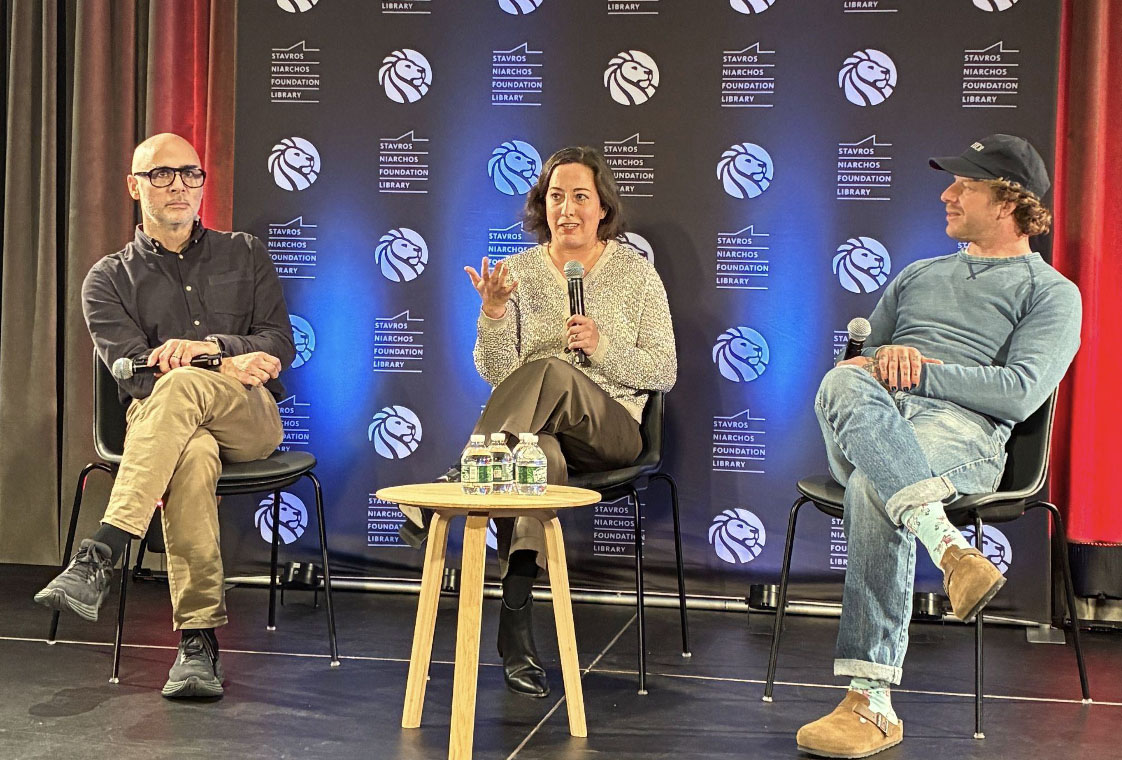
On a chilly Tuesday evening at the Stavros Niarchos Foundation Library on Fifth Avenue, the seventh floor community room was filled with the kind of New Yorkers who arrive early and defend their seats like rent stabilized apartments. Late fall sniffles punctuated the Sade and Bee Gees background music as audience members negotiated seats with the quiet intensity of regulars staking out their usual tables.
One man sat squarely in the middle of the sixth row and refused to move when an usher politely asked if he would slide down to the aisle. He looked her straight in the eye and said, “Are you trying to evict me? I won’t go!” The usher backed gently away.
A woman beside me arrived with two bulging bags and a schmatte coat piled so high on the chair there was nowhere to sit. Moments before the lights dimmed, she grabbed her schleppy stuff and darted for an open seat in the front row as if she was grabbing the only free counter seat on a Sunday morning. Russ & Daughters is a cultural landmark, and it felt like everyone in this crowd had a stake in the place.
Fourth generation co owners Niki Russ Federman and Josh Russ Tupper were joined by writer Joshua David Stein to discuss their new cookbook Russ & Daughters, 100 Years of Appetizing. Fresh of the press, published by Flat Iron, it is 342 pages with appetizing photographs by Gentl & Hyers of lox and bagels, matzoh ball soup, and other delights.
The book tells the Russ family story and everything that grew from it. Their great grandpa arrived in 1907 to help his sister sell herring from a single barrel on the Lower East Side. By 1914 they had a shop. Apparently, he wasn’t much of a people person, but when his three charming daughters started working for him, that’s when the business started to take off. In the 1930s he renamed it Russ & Daughters. Josh said, “It was the first business in the country with and daughters [in the name] instead of and sons.” Niki added that even now, “It is still incredibly rare to see a business that is and daughters.”
Almost immediately, that lady who grabbed the front row seat interrupted to ask if it was the first and daughters business in the whole world. It was a classic Lower East Side kibbitz, in its purest form.
Much of the conversation centered on continuity which Niki described as “the through line.” It meant “maintaining the history but modernizing in a way that does not disrupt it.” Stein slipped once and called Russ & Daughters a brandbefore correcting himself, as if the word cheapened something that has survived four generations.
The idea of continuity came up again when they talked about nearly signing a restaurant lease in Chelsea. Niki remembered feeling uneasy the night before. “I was starting to feel very uncomfortable,” she said. “I was just starting to feel that this was the wrong idea.” When she called Josh, he was having the same reaction. “It became crystal clear,” she said, “that the cafe had to be on the Lower East Side.” They stayed committed to the neighborhood just as their father did.
Josh talked about growing up in an ashram up state with his hippie mom before rejecting her lifestyle to study chemical engineering in college, before coming back to New York to join the family business. He told the audience that when he arrived “everyone gasped in horror” because he was left handed. The narrow counter requires that all knives be slicing in the same direction. It’s a tight space. One wrong move and you’re liable to take out an eye. Josh said he had no choice but to learn to slice with his right hand. “I cannot even sign my name with my right hand,” he said, “but I slice beautifully.”
Niki remembered childhood errands when the Lower East Side was still rough. “I was a scared kid,” she said. “Walking down Houston Street in the early eighties with the punk scene and burning trash cans.” In spite of the mean streets, she sensed “something magical happening in this space.” It was where people came “to connect to who they are and where they come from.”
Stein asked them to explain the difference between an appetizing store and a deli. Niki broke it down. “The delicatessen is where you go for your pastrami and corned beef. The appetizing store is where you go for fish and dairy,” she said. Bagels and lox, herring in cream sauce, pickled fish. Ready to eat foods rooted in Jewish dietary laws and New York immigrant life. “You are now inducted into the appetizing club,” she told the audience. Translation: you no longer have an excuse to call it a deli.
The Recipes
The cookbook section of the evening gave shape to the stories. Niki talked about recreating Aunt Ida’s stuffed cabbage, a recipe that never existed on paper. She contacted Ida’s eighty year old son in California and searched through community cookbooks like the one from Rochester Hadassah at the American Jewish Historical Society. Niki shipped version after version of stuffed cabbage to the West Coast until it tasted like Ida’s.
Josh’s favorite recipe is for the kasha varnishkes. He also likes the blintzes because they’re easy to make at home. The smoked salmon, herring and caviar sections are expert buyer’s guides for decoding the many varieties at the appetizing counter.
Jewish Museum Closure
During the Q and A, someone asked why the Russ & Daughters cafe at the Jewish Museum closed down. Niki explained that their agreement with the museum was up for renewal during COVID, when the business had shrunk from 150 employees to 50. “At one point we projected that if things kept imploding the way they were, Russ & Daughters had maybe six months to live,” she said. Closing the cafe was not symbolic. It was survival.
After the last question, the event wrapped. People gathered their personal belongings and drifted toward the exit, where a table had been set with Russ & Daughters black and white cookies and there was a line forming for the book signing. The moment carried the feel of the OG appetizing shop. On this night, they were still doing exactly that. Personally, as the writer of this story, I knew I had to own this cookbook.
Eric Schwartzman is an author, journalist, and AI visibility consultant.