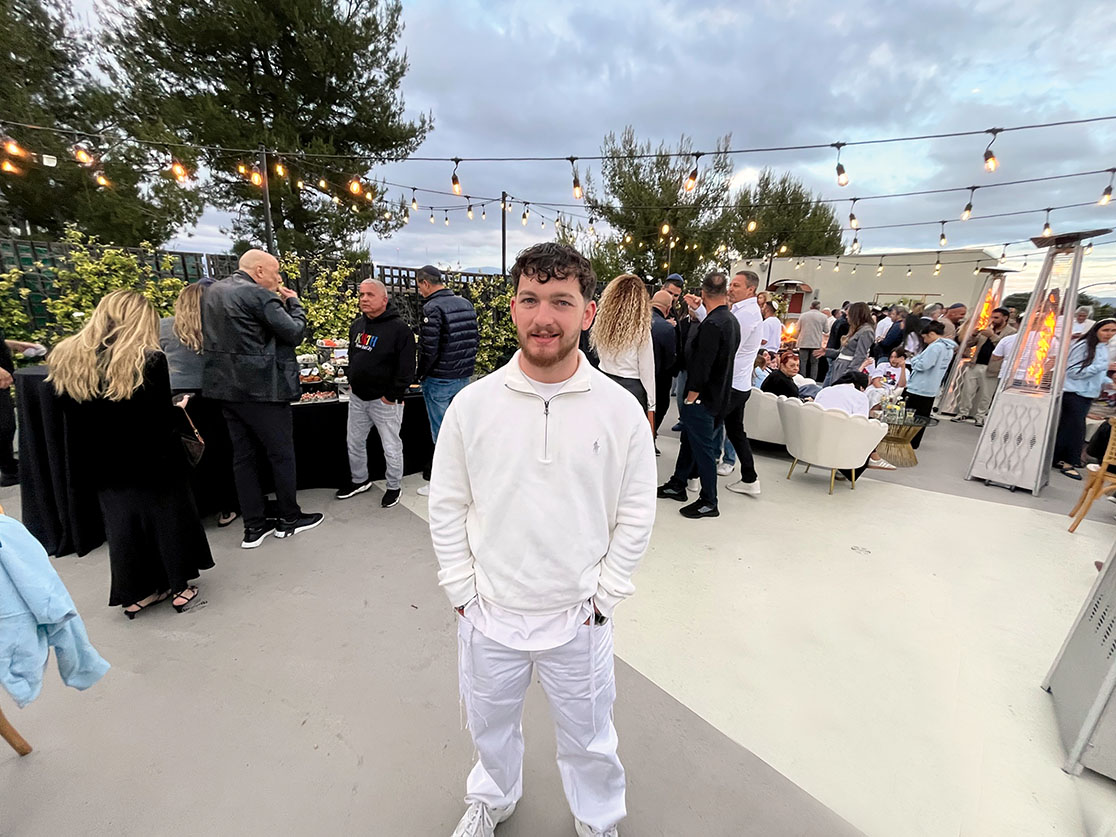
A spinoff of the hit first responder series “9-1-1,” Fox’s “9-1-1 Lone Star” aims to re-create the winning formula of outrageous-but-true emergencies mixed with personal drama. It stars Rob Lowe as Owen Strand, the sole survivor of his New York City firehouse after the Sept. 11, 2001 attacks, who is suffering from ground zero-related cancer. Tasked with re-staffing a fire station decimated by tragedy in Texas, he heads to Austin with his son named TK, an opioid addict who nearly dies in a suicide attempt after a breakup with his boyfriend. Ronen Rubinstein, best known for the Freeform series “Dead of Summer,” plays TK.
“I like that he’s troubled. I like that he has layers,” Rubinstein told the Journal. “It’s a very complex character to play. I grew up in Staten Island, N.Y., where there’s a bad opioid epidemic. I saw it in high school a lot, and I know how dark and rough it can be,” he said. On the brighter side, a new romance is in the offing. TK meets a police officer in the first episode, “and that develops into something really beautiful, something really fiery.”
After “sparks flew immediately” in a chemistry read with Lowe, Rubinstein was cast in his highest-profile role to date. “I’ve done television but nothing of this magnitude,” he said. “It’s a true honor to be included and to not only work with true legends like Rob and Liv Tyler, but to watch and learn from them every single day on set,” he said.
To prepare for the role, Rubinstein spent a day with the crew at a fire station in Van Nuys. “We ate with them, went out on calls with them,” he said. “An older lady had fallen and cracked her forehead open. I saw how they handled the situation, and it was pure calm. I focused on their body language and their demeanor in these situations because we’re going to see some hairy stuff.”
Rubinstein, 26, also had to get used to maneuvering in full firefighting gear. “With the [oxygen] tank it’s probably 60 pounds. To be in that gear for 12-14 hours takes a real toll on you, and you realize what these men and women go through in real life.”
Rubinstein, 26, also had to get used to maneuvering in full firefighting gear. “With the [oxygen] tank it’s probably 60 pounds. To be in that gear for 12-14 hours takes a real toll on you, and you realize what these men and women go through in real life.”
Moving to Austin to film was much less of an adjustment. “I fell in love with [Austin],” he said. “Luckily, I had a lot of days off and had time to explore. I met and hung out with the locals and got an incredible tour of the city. I can see myself living there in the next couple of years.”
A native of Rehovot, Israel, and the son of Russian immigrants, Rubinstein moved to the United States with his family when he was 5. His father, a dentist, served in the Israeli army and didn’t want the same for his children. “We didn’t grow up religious but my parents instilled pride in us in the traditions, the history and the culture of the Jewish people,” he said. “We observe the holidays every year, but my parents are in New York and my sister is in Seattle so it’s hard to get everyone together.”
Rubinstein was always interested in film, but sports took precedence until a guidance counselor suggested he try out for theater. “I was a troubled kid, and he said, ‘You need to get your act together.’ As cliché as it sounds, theater saved me,” he said. “I auditioned and got the lead in a play, and the rush of being on stage was everything; being on set all day and learning about the craft. I was hooked and I knew it was what I wanted to do with my life.”
Rubinstein moved to Los Angeles three years ago and immediately felt at home. “I think it’s because my roots are in Israel, where the climate is similar and it’s connected to nature. Blue skies and palm trees.” His first break was the lead role in the independent film “It Felt Like Love,” which screened at the Sundance Film Festival in 2013, and he has since appeared in “Orange Is the New Black” and the 2019 TV movie “Less Than Zero.”
“I’m proud of everything I’ve done but [‘9-1-1 Lone Star’] is the pinnacle,” he said.
He envisions a future that includes “important, meaningful projects, whether it’s on television or film. Writing and directing are in the back of my mind,” he said. He hasn’t been back to Israel since he left, “but I hope to go back soon. I’d love to do a movie there.”
An animal lover with two pet pit bulls, Rubinstein actively supports Stand up for Pits, which advocates for the breed. “There’s a lot of prejudice toward them and I’m trying to change the narrative,” he said. He also supports the Humane Society and Leonardo DiCaprio’s foundation to protect wildlife. “I’d like to try to help save this planet,” he said. “We have to wake up.”
Rubinstein’s main objective in whatever he does is to “always learn,” he said. “I always want to get better, as a professional, as a human and actor.”
“9-1-1 Lone Star” premieres Jan. 19 on Fox.