Individual identity is tricky and comes in at least three forms: the identities we assume, those that are thrust upon us and the ones that we can’t shake no matter how hard we try. Mike Katz, 35, knows all three types, and the topic surfaces as we discuss music in the noisy Bow Bar in Edinburgh, Scotland, at the height of the city’s famed festival.
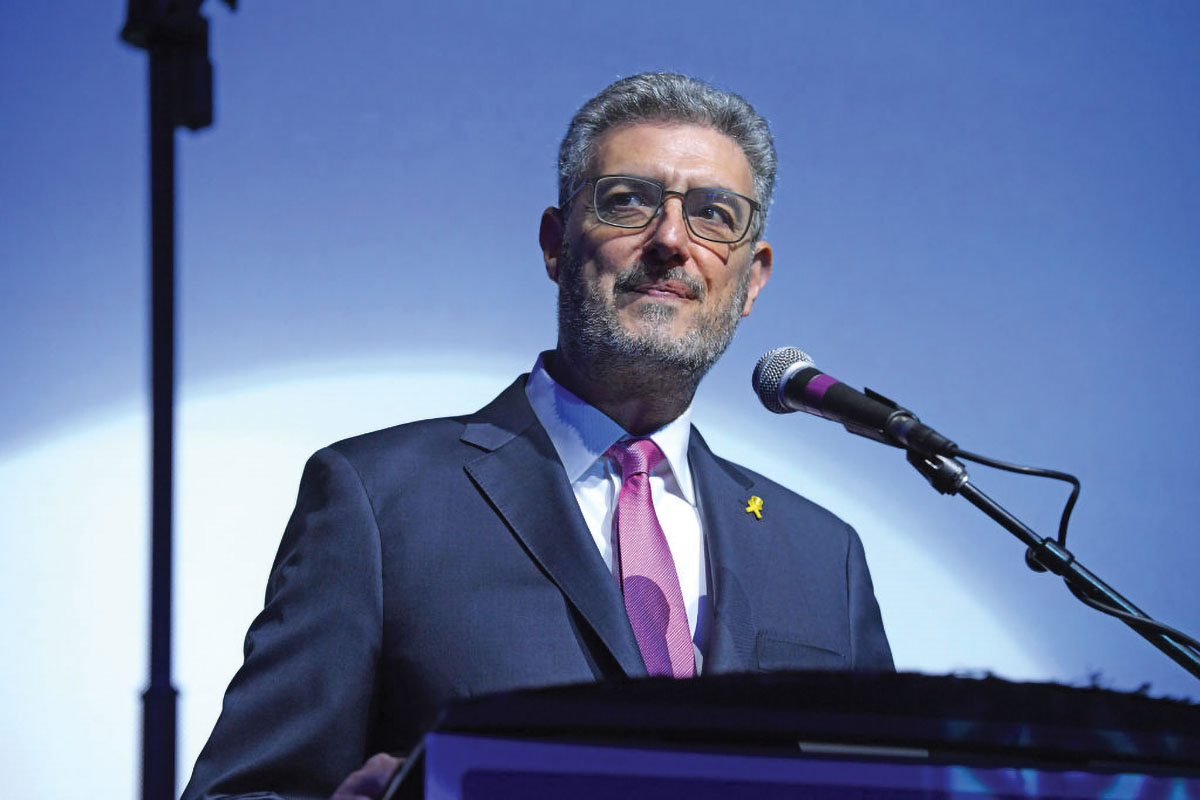
Since 1997, Katz has been the bagpiper for The Battlefield Band, a Scottish ensemble famed for fusing traditional tunes with contemporary and original influences. The genre is sometimes rather misleadingly labeled “rock and reel.” Katz — whose solo CD, “A Month of Sundays,” hits stores this week — doesn’t look like a Scotsman. He’s lanky and taller than most that tread Edinburgh’s cobblestones. But the thing that first strikes most people when they see Katz is his dark, wispy beard flowing about a foot from the base of his chin. Coupled with his round spectacles, he’d only need to don a yarmulke to be mistaken for a talmudic scholar.
Katz, whose band performs in Santa Monica Sept. 19, is intrigued by identity issues. He speaks with a thick brogue but doesn’t look Scottish for the simple reason that he isn’t — he’s a native Angeleno. The Scottish accent began as an affectation when he was a student at Edinburgh University.
“When I moved here I wanted to make myself understood,” Katz said. “Plus, there were places where Americans were not particularly popular. Now it’s just the way I talk.”
Seventeen years in Scotland have honed an accent that allows him to pass as native in cosmopolitan Edinburgh, with its mix of old-timers, Highlander imports and immigrants.
And Katz is certainly no talmudic scholar — he’s only half-Jewish. His mother is a non-Jew and his father is the son of a Sephardic Jew from Bessarabia who became a bagel baker upon immigrating to America. His paternal grandmother came from the Kiev ghetto. Both paternal grandparents knew anti-Semitism firsthand — few of Bessarabia’s 267,000 Jews survived the Holocaust.
Katz’s grandfather was lucky enough to get out, but Katz himself knew little of this history growing up. The family lived in Chatsworth where Judaism was more of a cultural than religious presence in Katz’s life.
“In the suburb where I spent my youth you simply presumed everyone was Jewish,” he said. “My relatives and neighbors were Jewish and my uncle planned to become a rabbi. The only Christian religion I had ever seen was the TV evangelists, and they seemed like such a joke that I didn’t think anyone could actually believe in this. As I got out more, I was surprised to find that most people were not Jewish.”
Katz’s next shock came when he went to a Catholic high school that, he said, “was so bad it’s best that it go unnamed.”
He was the oil to its water, and eventually left and finished high school in Van Nuys, but Catholic school provided a taste of assuming identity.
“I grew a long bushy beard as an act of rebellion,” he confessed.
Now he uses his beard as a prejudice filter.
“The people who pass you on the street and make negative comments are people I’d just rather not waste time talking with,” he said.
One might assume that Katz went off to Scotland to become a bagpiper, but that, too, is a product of his Los Angeles childhood.
“L.A. is a huge place and there’s a scene for everything, including piping,” he said. “I got into piping through my older brother and through listening to records. My brother eventually joined the Los Angeles Police Band, and he introduced me to its pipe master, John Massie, who was a great teacher. Because of John I was a really good player before I left Los Angeles, and because of listening to records I developed a good ear.”
At 18, Katz went to Scotland to study philosophy at Edinburgh University. He also worked in a pub and played bass and guitar in a very loud punk rock band.
“If I had stuck with it, I’d probably be a famous dead musician by now,” he joked.
Pub contacts eventually reconnected him to piping, especially when he befriended Gordon Campbell, a renowned player with the Vale of Athol Pipe Band.
“Gordon introduced me to records by Planxty and The Bothy Band and I had never heard bagpipes mixed with other instruments like fiddles and guitars and flutes. It had never occurred to me that Celtic music could rock.”
He eventually joined the well-regarded band Ceolbeg, and also played some gigs with John McCusker, who was then Battlefield’s fiddler. When Iain MacDonald left Battlefield, Katz was invited to join and has been a mainstay ever since.
For Celtic music fans, being a member of Battlefield Band holds esteem akin to how a classical music aficionado feels about the first chair violinist for the Los Angeles Philharmonic. Katz is now in his seventh year as Battlefield’s piper and has spent nearly half of his life in Scotland. In all, he had pretty much assumed a Scots identity. Or so he thought, until Sept. 11, 2001.
“I was in Germany on Sept. 11 and Battlefield had a gig for the next day that got canceled,” he recalled. “So I was walking around, when a Turkish guy drove by me and yelled out ‘Jew!’ Then I walked around the corner and a bunch of German school kids took a look at my beard and started calling me ‘Bin Laden!’ It was very funny, but also confusing. Then Battlefield went to America in November, and I noticed how in the cities there were all kinds of immigrants — Indians, Middle Easterners, Jews, Mexicans, Greeks — and everyone who looked different was getting hassled. There were flags everywhere and an assumption that all Americans looked a certain way. But when I went into one of the shops or restaurants run by immigrants, I got special treatment because I was one of them, which, of course, I am. Even in Aberdeen, people would say things in Yiddish to me, I’d get more food than anyone else, closed kebab shops would open when they saw me. Before they would have just called me ‘Jew,’ but, for a while, they were seeing that when everyone is getting treated badly, you’re all one.”
That said, despite a professed disinterest in organized religion, Katz learned that Jewish identity simply foists itself on you whether you seek it or not.
“Being Jewish isn’t necessarily about religion,” he said. “I have friends in the folk music community who are Jews and there are all these strange things we do that give us instant affinity. They have the same sense of humor; the same quirks. They talk like my uncle. I encounter people, like [folk music agent] Nancy Gross who couldn’t look more different than me. She’s half my size and female, yet she’s like my family we instantly understand each other.”
In the end, Katz said he feels Judaism is not something one can grow like a beard or reject like an American accent; it’s part of what defines you.
Scotland’s Battlefield Band will perform a two-hour concert on Sept. 19 at McCabe’s Guitar Shop, 3101 W. Pico Blvd., Santa Monica at 7 p.m. Tickets are $22.50. For information, call (310) 828-4497. Katz’s solo CD, “A Month of Sundays,” will be specially sale priced and positioned at Tower Record stores throughout Southern California through Oct. 4.
Rob Weir is a freelance writer and college professor living in western Massachusetts. His work has appeared in numerous newspapers and national magazines and he is the author of four books.