Rather than celebrating artistic freedom, this year’s Toronto International Film Festival became the locus of an artist-led, divisive boycott against Israel.
The controversy centered on Toronto’s choice of Tel Aviv for its inaugural City-to-City program, which showcases a series of films from a select city. The spotlight is an opportunity for the Israeli film industry to gain visibility at a festival that is considered among the most prestigious film festivals in the world and a launching pad for Oscar buzz.
What at first seemed like a natural choice, given the Israeli film renaissance of recent years, turned into a divisive fight over Israeli politics, initiated by John Greyson, a Canadian documentary filmmaker, who withdrew his documentary short from the festival in protest of the Tel Aviv sidebar.
A letter titled, “The Toronto Declaration: No Celebration of Occupation” quickly was drawn up, protesting the “celebratory spotlight on Tel Aviv” and the absence of films from a Palestinian perspective. That letter, calling Israel an “apartheid regime,” attracted a groundswell of support from such names as Jane Fonda, Harry Belafonte and Noam Chomsky, as well as David Byrne, Julie Christie and Wallace Shawn.
The protest campaign, in turn, provoked a counter-protest statement drawn up in Los Angeles and signed by some of the most powerful players in both the Jewish establishment and the entertainment industry.
“Anyone who has actually seen recent Israeli cinema, movies that are political and personal, comic and tragic, often critical, knows they are in no way a propaganda arm for any government policy,” the statement read. “Those who refuse to see these films for themselves or prevent them from being seen by others are violating a cherished right shared by Canada and all democratic countries.”
The Jewish Federation of Toronto, in partnership with The Jewish Federation of Los Angeles, created the counter-statement as an ad for The Global Mail, Canada’s national newspaper, expressing Hollywood’s support for the Tel Aviv spotlight. More than 100 Hollywood celebrities and industry leaders — including Natalie Portman, Jerry Seinfeld, Sasha Baron Cohen, musician Lenny Kravitz, producer Guy Oseary and CBS entertainment president Nina Tassler — signed under the tagline, “We don’t need another blacklist,” a reference to the mid-20th century Hollywood blacklist that denied entertainment professionals employment based on their politics.
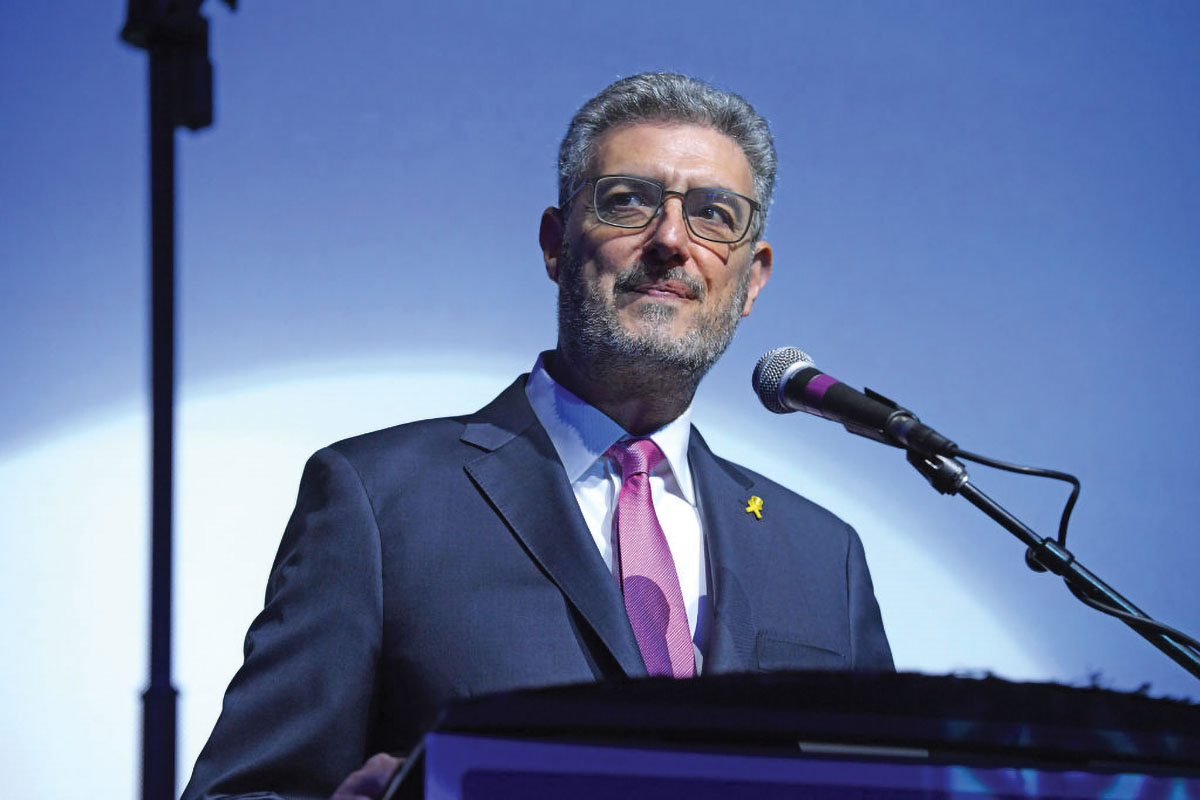
“We’re looking at an increasingly bitter battle for the hearts and minds of the public,” John Fishel, outgoing president of the Jewish Federation of Greater Los Angeles, said Sunday of the agency’s decision to participate. “We should never become complacent that a point of view in terms of the legitimacy of the State of Israel is shared by everybody. When you see opinion leaders who are household names saying untruths or distortions, it’s necessary to mobilize.”
“The Toronto Declaration” declared that Toronto “whether intentionally or not, has become complicit in the Israeli propaganda machine” and faulted Tel Aviv, in particular, for being “built on destroyed Palestinian villages.” The letter claimed that focusing on Tel Aviv without including perspectives from the West Bank or the Gaza Strip is “like rhapsodizing about the beauty and elegant lifestyles in white-only Cape Town or Johannesburg during apartheid without acknowledging the corresponding black townships of Khayelitsha and Soweto.”
From the beginning, the back and forth has been intense.
Festival co-director Cameron Bailey defended the Tel Aviv program in an open letter on the festival’s Web site, writing that although Tel Aviv “remains contested ground,” he was attracted to Tel Aviv “because the films being made there explore and critique the city from many different perspectives.”
And there has also been some back-stepping: On Tuesday, Jane Fonda issued a clarification on The Huffington Post, after Rabbi Shlomo Schwartz, director of the Chai Center, contacted her. She said she had “signed the letter without reading it carefully enough” and that “some of the words in the protest letter did not come from my heart.”
Opponents of the protest do not support punishing Israeli filmmakers — many of whom are vocal critics of their government — because that is seen as an act of censorship.
“The most ardent critics of the State of Israel are its own filmmakers,” said independent producer Tom Barad, who drafted his own counter-protest letter. His letter attempts to dispel the charges against Israel by looking at history.
“The entire world was formed through military victories and defeats,” Barad said by phone from St. Louis. “Every state since the beginning of nations has been formed this way, but only Israel is continually disclaimed from its legitimate right to exist.”
Other Hollywood notables, including David Cronenberg, Norman Jewison and Ivan Reitman have also publicly denounced censoring the Tel Aviv program. “Film is essentially about telling global stories, exploring the complexities and contradictions of the human condition,” Reitman told The Hollywood Reporter. “Any attempt to silence that conversation, to hijack the festival for any political agenda, in the end, only serves to silence artistic voices.” Jewison — who is not Jewish — told the trade the protest “smacks of anti-Semitic bigotry.”
Although Federation President Fishel didn’t call it anti-Semitism, he said the vitriolic charges against Israel may hint at something more invidious than artistic censorship: “I see this as a pitch battle in the context of a larger war about reinforcing the legitimacy of the State of Israel,” Fishel said. He and entertainment division director Meredith Weiss orchestrated the support ad, which Fishel says was well received in Hollywood.
“Many of these people have visited Israel and seen with their own eyes that Israel is a complex country and that the creative work of some in the film industry is very critical of Israeli society and government and they think that’s healthy,” Fishel said.
“Everybody realizes that boycotting the free exchange of ideas and calling Israel an apartheid state is a false analogy and unacceptable,” though he added, with resignation, “I regret to say it won’t be the first or last time we’ll have to deal with this type of thing.”