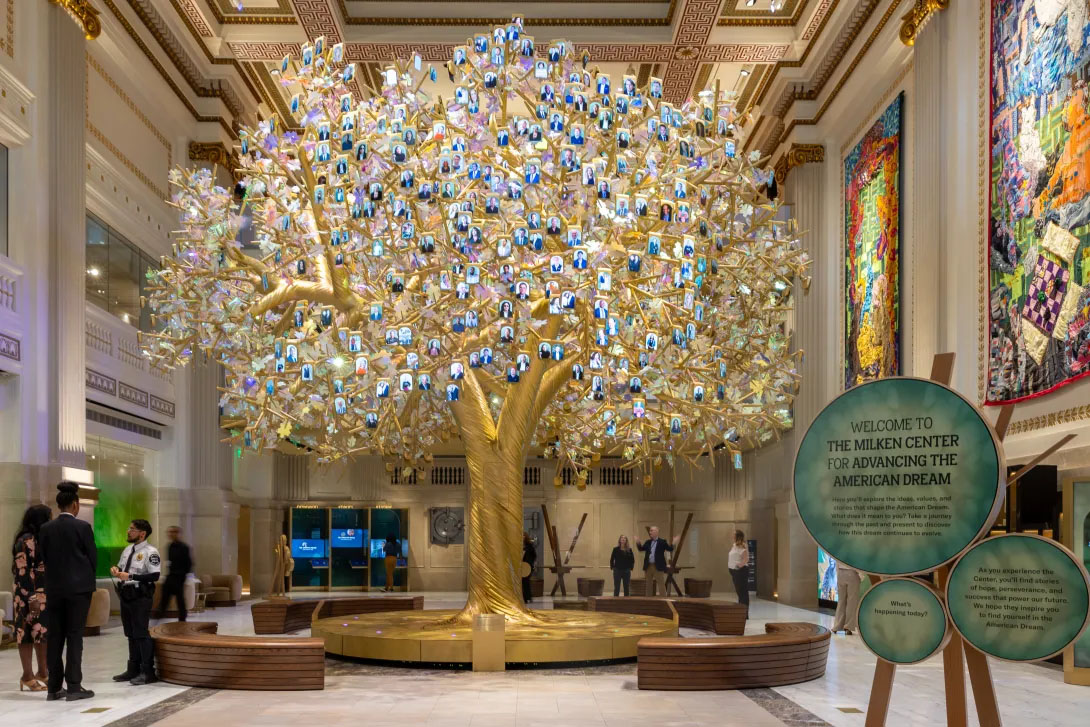
There are two ways to approach the new Milken Center for Advancing the American Dream in Washington, D.C., caddy corner from that other monument to dreamers, The White House.
One way is to allow the fever of cynicism and mistrust that is corroding our country’s discourse to color everything you see.
The other is to crack through the cynicism and allow the search for an innocent truth to come to the surface.
On my visit this week, I followed the second approach. The first one was too easy. It’s too easy to assume that because so many institutions in America have lost the people’s trust, that the American Dream itself should fall into that camp.
It doesn’t.
In fact, although the American Dream has taken its lumps in recent years amidst the politicization of everything, it may be the last innocent idea we have left; the last hope for something that has any chance of bringing our country together.
It’s as if the founders of the museum understood this. There’s not a breadcrumb of cynicism in the place. While the museum is housed in a spectacular setting of former bank buildings that have been renovated to keep their authenticity, complete with the dramatic ceilings and other cues of classic buildings from a century ago, the actual content on display revolves around a simple human idea: dreaming.
Which human being has not dreamed?
In that sense, because dreams never end and are always renewing themselves, nothing really ends at this museum; it’s all beginnings. The exhibits on display are like jumping points. They trigger your own dreams. At any point, one is likely to ask, “How can this apply to my life, to my dreams?”
There’s a significant amount of content that delves into the many aspects of the American Dream, from its history to its meaning to how it has impacted the world, our country and our people and continues to do so today. There’s also a significant amount of useful information on finding and nurturing one’s dreams, as well as an interactive component that engages visitors.
The museum experience has a natural flow; new ideas keep coming at you and are displayed with a sense of continual discovery. As it says on its website, you get to experience “an interactive exhibition where bold ideas, powerful stories and immersive technologies invite you to visualize your potential in new ways.”
The human stories are crucial to the experience. They take a grand idea and bring it to life, with real stories, real people, real dreams.
These stories contribute to what I see as the unspoken and real power of the museum, which is its innocence.
Indeed, the information conveyed is so earnest, thoughtful and human one can’t help but see the American Dream in a fresh way, as an idea worthy of embracing, or at least rediscovering.
In other words, if you bring a cynical vibe to your visit, nothing in the museum will nourish that vibe. Quite the contrary: this the American Dream served straight up and aspirational, the American Dream for those who take dreaming seriously.
This innocence also comes across with a surprisingly joyful vibe given the vastness of the space. Something about the art, the colors, the layouts, the images, feels enchanted.
You feel it as soon as you enter, greeted by a giant tree that grows human faces on its golden branches. Although the art and designs on display usually have an intentional quality, you don’t need to know any of that to feel the enchantment. It’s in the air.
Of course, even this joyful spirit has a rational explanation. What good is the pursuit of a dream if it doesn’t bring you joy? How can a life be made better without the fruit of joy?
Because the act of dreaming is so essential to life, because the desire to make our lives better has existed since time immemorial, this museum is really about life itself, about the innocent and timeless search for a better life.
How ironic that it is situated in the very antidote to innocence; the place where the government shuts down, where the biggest dream is to crush your political opponent, where cynicism becomes a survival mechanism.
It is true that in this divisive battle zone we live in, the American Dream has somewhat vanished from the public discourse; at best, it has become a talking point from a politician you don’t trust.
The museum makes no downbeat references to any decline. It doesn’t have to. What it does is provide survey results it commissioned from Gallup that shows a lot more optimism across the country than I expected.
But more importantly, regardless of any outside news, the museum provides the nourishment you need to create your own dream. It doesn’t sugar coat anything. It doesn’t shy away from the value of hard work or the values of capitalism. What it does is show dreamers how to put the odds on their side.
Can it rescue the American Dream from cynical politicians? That’s for commentators to discuss, not the museum. The museum is not an op-ed.
But by its very location in the heart of our political battlefield, the museum is making a defiant statement that there is a better, more unifying way.
I don’t know if the founders intended this, but they have created a monument to what our nation could really use right now: a return to the human idea of aspiration and the simple power of innocence.