Category
influence
Obama ties to ‘separatist’ pastor raise big questions
Democratic presidential front-runner Obama survived a malicious viral e-mail campaign that he was a Muslim. But can the populist candidacy of the Illinois senator survive the truthful revelations about his 20-year relationship with his spiritual adviser, the Rev. Jeremiah A. Wright, the \”black separatist\” Christian pastor?
Authors explain Jewish influences on their works
The Jewish Journal invited writers who will be featured at Sunday\’s Festival of Books to answer the simple, essential question that every Jewish writer is often asked: \”What Jewish sources — ideas, writings, traditions — inspire you, and how do they show up in your work?\” The following show that there is no easy answer to what defines a Jewish author, but there is no question that there\’s much to draw upon within the faith.
Thirty Years of Carlebach Rock
Moshav Band, which was founded as a direct result of Carlebach\’s influence, just released its first English only album — \”Misplaced.\”
Fifty Nifty Tribemembers
There are, according to The Forward newspaper\’s recently published \”Forward 50\” — a listing of the 50 most-influential Jews in America — at least seven Angelenos whose voices are being heard way beyond the West Coast.
A Mother’s Wish for Her Daughter’s Day
Despite our tradition that sets the 13th year as the start of adulthood, 13 is not the end of childhood or the beginning of adulthood. Instead, it is the start of a new stage — teenager. Neither an adult nor child, a teenager is like Dr. Doolittle\’s Push-Me, Pull-You: Sometimes he seems to be pushing toward adulthood, and at other times he is pulling back toward childhood.
One Historian’s Look at How Jews Shaped the Modern Age
\”The Jewish Century,\” by Yuri Slezkine. (Princeton University Press, $29.95).
Yuri Slezkine opens this major new book by declaring: \”The modern age is the Jewish age, and the 20th century, in particular, is the Jewish century.\” This assertion may ring bells.
Do We Have Anything Left to Give?
Do the Jews have anything left to give to America?\n\nThis question was on my mind recently, after I was on a panel at Brandeis-Bardin Institute to discuss the Jewish influence on American culture. The popular view on this subject is invariably, \”Just look at all the Jews who run Hollywood and the media; look at the humor, the attitude, the Yiddish terms, etc. Jews are everywhere.\”\n\nThis is true, but when you start to look beneath the surface, you see a more complicated picture, one that suggests the waning influence of Judaism and the need to re-examine the Jews\’ role in America as we begin the 21st century.
Students Sound Off on War in Mideast
\”The U.S. had all the right reasons for going to war with Iraq without the support of United Nations,\” said Jordana Friedman, an eighth-grader at Kadima Hebrew Academy in Woodland Hills. \”[Their leaders] lied. They said they were disarmed. Do we want another Sept. 11? I think we\’re totally justified.\”
New Articles

On Counting the Omer

A Memorable Mimouna

Campus Watch April 25, 2024
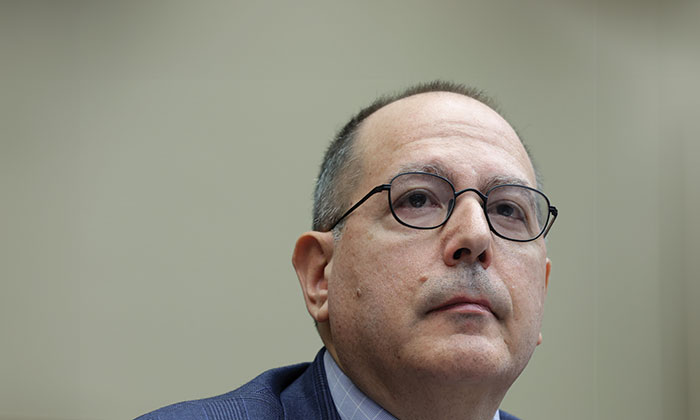
Will Columbia’s Law School Dean Learn the Law of Free Speech?
 More news and opinions than at a Shabbat dinner, right in your inbox.