Critical Race Theory Is What’s Still Wrong With California’s Ethnic Studies Model Curriculum
It creates a discriminatory, hostile and disempowering educational environment.
It creates a discriminatory, hostile and disempowering educational environment.

The COVID-19 crisis demands a re-evaluation of what it means to be “one Jewish community.” Help and solidarity cannot—and must not—be a one-way street.

As Jews, we are compelled by our history and our faith not to spread conspiracy theories.
The world of Jewish news is now available for both the iPhone and Android.
Commentary, the seminal neoconservative magazine, has donated its archives to the University of Texas at Austin.
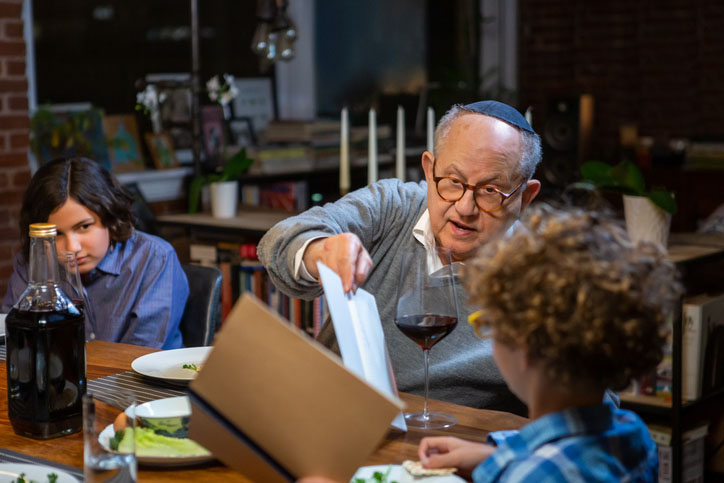
This season, several new haggadahs raise new questions. New interpretations bring new approaches to the seder, enabling readers and participants to bring new layers of meaning to their own celebrations of the holiday.
As Cantor Sarah J. Sager began her research, she found there were many people — both women and men — who were thinking about the silence of women in the Jewish tradition, and working to create \”a sense of women\’s presence at the most important moments of our history and in our most sacred text,\” Sager later wrote. But there was no one place to find all that commentary. Fifteen years later, the WRJ is publishing \”The Torah: A Women\’s Commentary,\” edited by Tamara Cohn Eskenazi, a professor at the Los Angeles branch of Hebrew Union College-Jewish Institute of Religion.
The Reform movement will soon publish a commentary on the Torah that gives the woman\’s perspective. \”The Torah: A Women\’s Commentary,\” a project of Women of Reform Judaism (WRJ), the movement\’s women\’s division, is a collaboration of 80 biblical scholars, archaeologists, rabbis, cantors, theologians and poets from across the religious spectrum — all of them women who came together to present a new perspective on the Bible.
 More news and opinions than at a Shabbat dinner, right in your inbox.