


Advertisement
View the most popular tags overall?
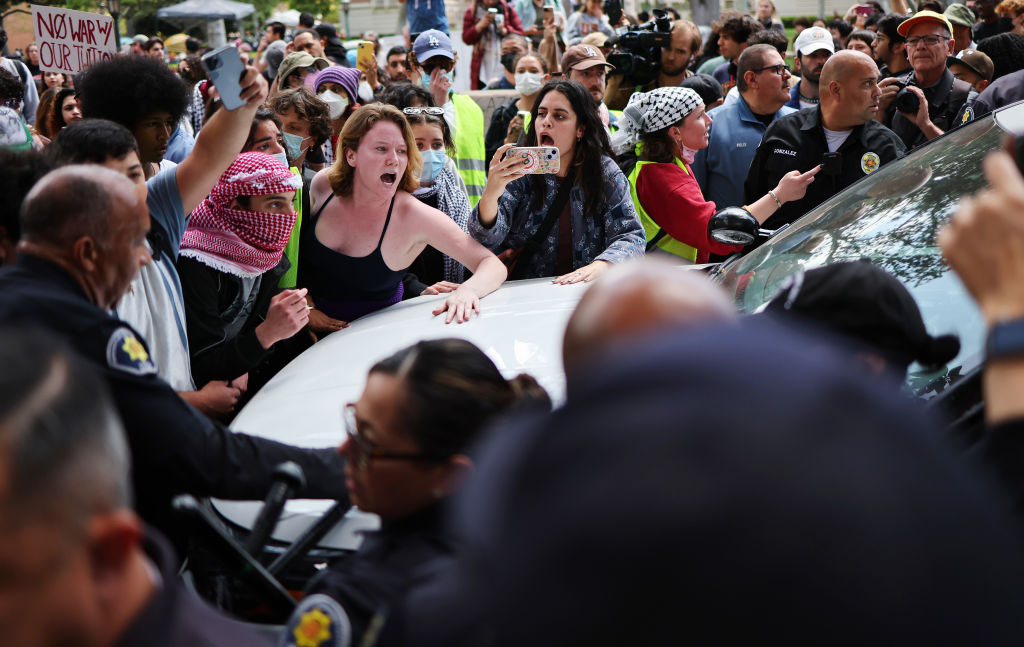
Over the past decade, as anti-Israel demonstrations have become a regular occurrence on many U.S. college campuses, Jewish nonprofits and individuals have turned to the U.S. Department of Education (DOE) for relief, and with some success. They convinced the DOE’s Office for Civil Rights (OCR), for one, to investigate anti-Israel speech and actions at three University of California campuses, arguing that such speech is tantamount to anti-Semitism and violates the civil rights of Jewish students.
I've never understood why they call a last-minute election ploy an "October Surprise," other than the fact that it usually happens in, you know, October.
letters to the editor
Josef Avesar says of the Israelis and Palestinian Arabs that "each side demands that the other relinquish crucial aspects of its identity," and that therefore, some form of confederation would be a "pragmatic" solution to their problems ("Mideast Solution: A Confederation," Nov. 3). Both Avesar's diagnosis and prescription are wrong.
Calling for condemnation of the IDF's use of cluster bombs against Hezbollah would degrade Israel's ability to defend herself, thus encouraging Hezbollah to again employ their vast rocket and missile inventory to terrorize and murder Israeli civilians and to damage Israel's economy ("Cluster Silence," Oct. 31).
Bill Dalati, a Syrian-born insurance agent, is running for a spot on Anaheim's City Council. His candidacy has come under scrutiny because of his association with a controversial organization with known links to the Hamas terror group and his participation at a virulently anti-Israel rally this past summer.
Community Briefs
The Council on American-Islamic Relations' (CAIR) new report titled, "Unpatriotic Acts," warns that acts of hate against Muslims in the United States skyrocketed in 2003. At face value, the numbers are grim: CAIR notes a 70 percent increase in "reports of harassment, violence and discriminatory treatment" against Muslims in the United States between 2002 (602 acts) and 2003 (1,019 acts). That also represents a 300 percent increase between the years 2000 and 2003.
Those numbers, however, do not entirely speak for themselves. Tracking hate is a complex process; statistics may be influenced by outside variables. That's especially true since the CAIR report also includes noncriminal acts of discrimination, sometimes called "hate incidents." CAIR is not alone in using this methodology: Some groups tracking anti-Semitism do the exact same thing.
Community Briefs
Amid the profusion of billboards along Southern California freeways, motorists are being startled by a new one. It features seven smiling faces of various ethnicities, with one, a woman wearing a black headscarf, holding a small American flag.
Advertisements
Advertisements