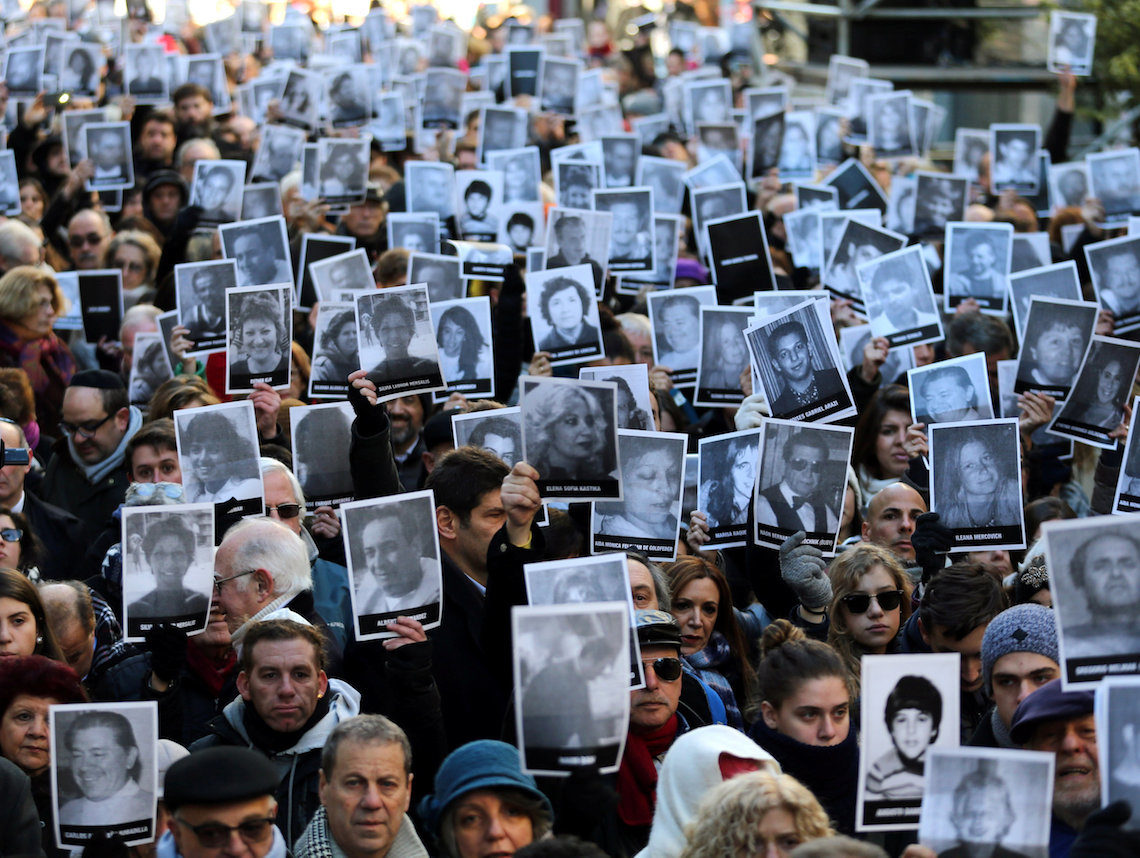
How the rabbi who never knew Alberto Nisman became his family’s pastor
In January 2015, Rabbi Marcelo Polakoff was stuck in Buenos Aires when his phone rang.
Argentine president ‘determined’ to discover truth of Nisman’s death
Argentine President Mauricio Macri said he is “determined” to discover the truth about the death of AMIA prosecutor Alberto Nisman.
Argentine prosecutor asks court to reopen Nisman complaint against ex-president
A federal prosecutor has asked an Argentine court to reopen the complaint filed by the late special prosecutor Alberto Nisman charging that former President Cristina Fernandez de Kirchner covered up Iran’s role in the 1994 AMIA Jewish center bombing.
New Argentine president pledges to cancel pact with Iran on AMIA bombing
The newly elected president of Argentina said he will cancel the agreement signed with Iran to jointly investigate the 1994 attack on the AMIA Jewish center in Buenos Aires, as he vowed during the campaign.
New tests negate possibility of Nisman suicide
The results of new tests on the gun believed to have killed Alberto Nisman appear to negate the possibility that the AMIA special prosecutor committed suicide.
Iranian suspect in AMIA bombing denies involvement, cites ‘influence of ‘Zionism’
An Iranian suspect in the 1994 attack on the Buenos Aires AMIA Jewish center denied that his country was involved and blamed Argentina for being “under the influence of Zionism.”
Alberto Nisman was a ‘scoundrel,’ Argentinian Cabinet chief tells reporters
Argentinian Cabinet Chief Aníbal Fernandez called the late AMIA special prosecutor Alberto Nisman a “scoundrel” and a “wretch.”\n
Nisman’s ex-wife: Late AMIA prosecutor was murdered
Forensic tests on the body of an Argentine state prosecutor who died days after accusing President Cristina Fernandez of plotting to cover up Iran\’s alleged role in a 1994 bombing indicate that he was murdered, his ex-wife said on Thursday.
Kirchner: AMIA and embassy bombings were ‘collateral damage’
Argentina’s president called the deadly attack on the AMIA Jewish community center in 1994 and the attack on the Israeli Embassy in 1992 “collateral damages in a war in which we had never been part, nor want to be.”



 More news and opinions than at a Shabbat dinner, right in your inbox.