Quantcast

Search our Archives!


Advertisement

Swindler's List

December 26, 2008 | 3:59 am RSS

Wiesel Foundation lost ‘substantially all’ of its savings

Posted by Brad A. Greenberg

Photo

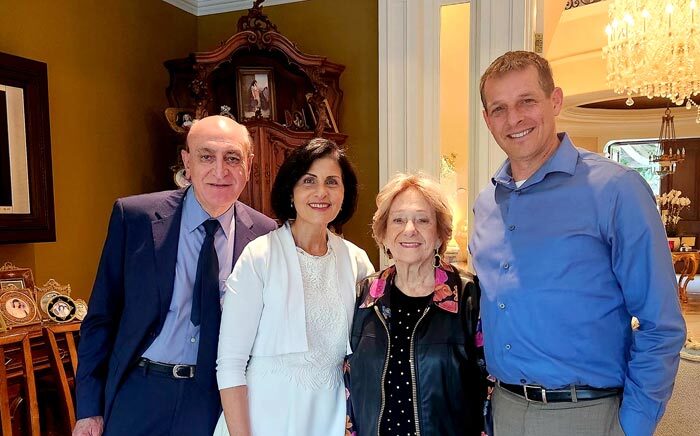
Shortly after the Madoff scandal broke, the name Elie Wiesel was mentioned in the discussion of notable Jews who’d lost a ton of cash as a result of the massive Ponzi scheme. It wasn’t Wiesel personal money, but that of the Nobel Peace Prize winner’s foundation. Yesterday, the Wall Street Journal reported just how much money the Elie Wiesel Foundation for Humanity lost: “substantially all.”

“We are deeply saddened and distressed that we, along with many others, have been the victims of what may be one of the largest investment frauds in history. We are writing to inform you that the Elie Wiesel Foundation for Humanity had $15.2 million under management with Bernard Madoff Investment Securities. This represented substantially all of the Foundation’s assets.”

Somehow, the foundation said in a statement that it will carry on and won’t be distracted from its mission. Not sure how they’re going to pay the rent.


The Jewish Journal believes that great community depends on great conversation. So, jewishjournal.com provides a forum for insightful voices across the political and religious spectrum. Bloggers are not employees of The Jewish Journal, and their opinions are their own. Our entire blog policy is here. Please alert us to any violations of our policy by clicking here. (editor@jewishjournal.com). If you'd like to join our blogging community, email us. (webmaster@jewishjournal.com).

December 25, 2008 | 4:51 am

Bernie Madoff: Bad for the Jews, good for JewishJournal.com

Posted by The Web Guy

I want to thank Brad Greenberg, David Suissa, Danielle Berrin, Rob Eshman, Dean Rotbart and Tom Teicholz for their hard work on this (experimental?) group blog and make sure they know all the hard work has paid off.

Bernie Madoff may be bad for the Jews, but he has been good for JewishJournal.com, bringing a record number of visitors

Most are new people ('drive-bys') who come here because they find us with a search engine.*

Here's what they're searching for tonight:

Top Search Terms, Christmas Eve 2008
5.65%jewish journal
5.08%madoff jewish
2.82%bernie madoff
2.26%jew journal
2.26%jewish journal los angeles


Most people use Google:


ALTTEXT


*My job is to entice/inspire/incent these new people to stick around, explore the site a little, have a nosh, and [SCORE!] come back for more.

4 CommentsLeave your comment

December 24, 2008 | 6:25 pm

NYU sues Merkin over Madoff losses

Posted by Brad A. Greenberg

And here ... we ... go:

Hedge fund executive Ezra Merkin has been sued again for entrusting investments with confessed swindler Bernard Madoff, this time by New York University, which said it lost about $24 million.

The lawsuit in New York State Supreme Court is among a series against Merkin and other funds during the past week as investors seek to recover losses from the purported $50 billion Madoff scandal that would be Wall Street’s biggest fraud.

A judge issued a temporary order on Wednesday, barring Merkin from liquidating Ariel Fund Ltd, named in the lawsuit by New York University, which calls itself the largest private university in the United States.

The order, which expires on January 6, will have no impact on plans announced December 18 to wind down the Ariel fund, Merkin’s attorney Andrew Levander said in a statement. He said the investment manager would not receive fees and attorneys had promised to preserve documents.

“Mr. Merkin remains committed to obtaining for shareholders the best results possible in the wake of the terrible fraud committed by Bernard Madoff,” the statement said.

Madoff, a 70-year-old investment adviser and former chairman of the NASDAQ stock market, was arrested on December 11 and charged with securities fraud. Authorities said Madoff confessed to running a $50 billion Ponzi scheme in which early investors were paid off with the money from new clients.

He is under house arrest in his Manhattan apartment on $10 million bail.

Investors can also make claims for money lost with Madoff through the Securities Investor Protection Corp (SIPC), which is overseeing the liquidation of Bernard L. Madoff Investment Securities LLC via a court-appointed trustee.

A U.S. bankruptcy court judge on Tuesday authorized the nonprofit group, created by Congress in 1970, to mail claim forms to customers in the first week of January. Customers have six months to return the forms.

“They will return those claim forms to the trustee with data indicating what they believe they were owed, how much they put in, how much they withdrew,” said Stephen Harbeck, SIPC president and chief executive. “Since the records in this case are unreliable, the more information people can get us the faster we will be able to satisfy the claim.”

1 CommentsLeave your comment

December 24, 2008 | 4:46 am

Days before Madoff was arrested, he still seemed a white knight

Posted by Brad A. Greenberg

Bernard Madoff made the cover of The Journal this week. Not that he didn’t dominate the inside pages last week, but as our editor in chief, Rob Eshman, told the L.A. Times: “In a word, it’s a catastrophe—by far the biggest Jewish story of the year.”

I’d actually venture that it’s the biggest story in years, and I anticipate it dominating my reportage for the next few weeks.

Here is the opening of my most recent contribution:

The stock market had been hammered for more than a year, but the Jewish Community Foundation (JCF) was doing relatively well, David Polak, chair of the JCF’s investment committee, told the board of directors early this month.

The JCF’s common investment pool, which manages the endowments for some of Los Angeles Jewry’s biggest social service agencies, was down for the year—but only by about 19 percent. Its performance could be attributed, at least in part, to one of the investment pool’s money managers. Polak didn’t identify this apparent financial all-star, which in terrible economic times had managed this year to produce almost a double-digit return on investment.

But less than 10 days later, everyone knew the name: Bernard L. Madoff Investment Securities.

Last week, as the largest Ponzi scheme in history claimed hundreds of millions of dollars from Jewish organizations and institutions, the JCF reported it had lost an $18 million investment that had grown to $25.5 million on paper. Overnight, 9 percent of the money some L.A. Jewish nonprofits use to generate cash for their programs vanished.

“No one is happy, including us,” said Marvin Schotland, JCF president and CEO. “But there has been an enormous amount of understanding about the unique set of circumstances that caused this to occur that could not have been foreseen or expected. It’s a testament to the strength of the community, at least with respect to donors who have funds with us.”

“They have not been engaged with blaming,” he said. “They have not been happy, but they have understood this is an aberration.”

The article goes on to discuss how the foundation came to invest a portion of its common-investment pool in Madoff and exactly what this is going to mean for participating organizations like Jewish Family Services. You can read the rest here.

0 CommentsLeave your comment

December 22, 2008 | 5:23 pm

Being Bernie: A theory

Posted by Tom Teicholz

Last night at a dinner party, the talk was about Madoff, as I’m sure it is at Hannukah parties and Holiday get-togethers everywhere.

One attendee who had a long and storied career in finance told me that he knew Madoff and was shocked—“Madoff was a pillar,” he said, “He was head of Nasdaq!” But all those years of returns, didn’t that make you suspicious? I asked. “I never thought it was a Ponzi scheme,” he said, “What I thought was going on was that he was front-running…, that’s how I thought he got those returns” (“front running is a form of trading, which is illegal, and consists of making trades ahead of a large order, in order to get a better price and make a profit. In Madof’s case, since he controlled such large investments, he had the power to make make large trades and to know those large trades were about to happen).

Another guest, who works in the literary and difital world had a more charitable take on things: “Madoff did what he did, not because he wanted to do bad and defraud clients, but because he wanted to do good and couldn’t deliver and then fell behind…..”

And as he said it, a lightbulb of sorts went off in my head. Madoff liked being the guy who delivered 10% returns come hell or high water. Madoff liked being “Uncle Bernie,” the so-called “Jewish T-Bill.” Madoff like being the philanthropist who gave to Jewish charities, who helped people,. who made a difference.

And in order to maintain being Bernie Madoff, Madoff needed cash, Madoff needed new investors. Madoff built a giant Ponzi scheme. 

In the end Madoff was no different than Whitey Ford who cut his ball, and greased his hair to rub it on the ball, to insure that he could deliver the strikes he was famous for. Even Bernie Madoff could not support being Bernie Madoff.

4 CommentsLeave your comment

December 22, 2008 | 5:07 pm

Add Alexandra Penney, former Self Magazine editor and self help author to the list of Madoff victims

Posted by Tom Teicholz

As she writes in The Daily Beast, Alexandra Penney, self help author and former editor of Self magazine lost all her savings in the Madoff fraud.  Read it here.

1 CommentsLeave your comment

December 21, 2008 | 8:00 pm

Bernard Madoff Fantasy Finance League

Posted by Brad A. Greenberg

Photo

The New York Times yesterday published an in-depth exploration of the Bernard Madoff web of lies. It begins:

By the end, the world itself was too small to support the vast Ponzi scheme constructed by Bernard L. Madoff.

Initially, he tapped local money pulled in from country clubs and charity dinners, where investors sought him out to casually plead with him to manage their savings so they could start reaping the steady, solid returns their envied friends were getting.

Then, he and his promoters set sights on Europe, again framing the investments as memberships in a select club. A Swiss hedge fund manager, Michel Dominicé, still remembers the pitch he got a few years ago from a salesman in Geneva. “He told me the fund was closed, that it was something I couldn’t buy,” Mr. Dominicé said. “But he told me he might have a way to get me in. It was weird.”

Mr. Madoff’s agents next cut a cash-gathering swath through the Persian Gulf, then Southeast Asia. Finally, they were hurtling with undignified speed toward China, with invitations to invest that were more desperate, less exclusive. One Beijing businessman who was approached said it seemed the Madoff funds were being pitched “to anyone who would listen.”

The juggernaut began to sputter this fall as investors, rattled by the financial crisis and reaching for cash, started taking money out faster than Mr. Madoff could bring fresh cash in the door. He was arrested on Dec. 11 at his Manhattan apartment and charged with securities fraud, turned in the night before by his sons after he told them his entire business was “a giant Ponzi scheme.”

The case is still viewed more with mystery than clarity, and Mr. Madoff’s version of events can only be drawn from statements attributed to him by federal prosecutors and regulators as he has not commented publicly on the case.

But whatever else Mr. Madoff’s game was, it was certainly this: The first worldwide Ponzi scheme — a fraud that lasted longer, reached wider and cut deeper than any similar scheme in history, entirely eclipsing the puny regional ambitions of Charles Ponzi, the Boston swindler who gave his name to the scheme nearly a century ago.

“Absolutely — there has been nothing like this, nothing that we could call truly global,” said Mitchell Zuckoff, the author of “Ponzi’s Scheme: The True Story of a Financial Legend” and a professor at Boston University. These classic schemes typically prey on local trust, he added. “So this says what we increasingly know to be true about the world: The barriers have come down; money knows no borders, no limits.”

While many of the known victims of Bernard L. Madoff Investment Securities are prominent Jewish executives and organizations — Jeffrey Katzenberg, the Spitzers, Yeshiva University, the Elie Wiesel Foundation and charities set up by the publisher Mortimer B. Zuckerman and the Hollywood director Steven Spielberg — it now appears that anyone with money was a potential target. Indeed, at one point, the Abu Dhabi Investment Authority, a large sovereign wealth fund in the Middle East, had entrusted some $400 million to Mr. Madoff’s firm.

Regulators say Mr. Madoff himself estimated that $50 billion in personal and institutional wealth from around the world was gone. It vanished from the estates of the North Shore of Long Island, from the beachfront suites of Palm Beach, from the exclusive enclaves of Europe. Before it evaporated, it helped finance Mr. Madoff’s coddled lifestyle, with a Manhattan apartment, a beachfront mansion in the Hamptons, a small villa overlooking Cap d’Antibes on the French Riviera, a Mayfair office in London and yachts in New York, Florida and the Mediterranean.

Just as the scheme transcended national borders, it left local regulators far behind. Its lies were translated into a half-dozen languages. Its larceny was denominated in a half-dozen currencies. Its warning signals were missed by enforcement agencies around the globe. And its victims are now scattered from Hollywood to Zurich to Abu Dhabi.

Indeed, while the most visible pain may be local — an important charity forced to close, an esteemed university embarrassed, a fabric of community trust shredded — the clearest lesson is universal: When money goes global, fraud does too.

If you’re reading this blog, you’ve got to read the rest of the Times penetrating look at what went wrong and how so many people lost so much. Particularly troubling are all the middlemen wealth managers we’ve been reading about—you know, those guys who invested their clients money with Madoff, often unbeknownst to their clients.

“Is it possible that all these fund managers and investors were in the dark about what Madoff was doing?” Mark Lacter asked on his business blog “Not likely.”

That perception, and it’s a common one, is going to feed lawsuits that will last for years to come. Stanely Chais is already defending himself against one.

0 CommentsLeave your comment

December 21, 2008 | 6:20 pm

No place for hate on JewishJournal.com

Posted by The Web Guy

Photo

As news of the Madoff scandal ripples across the WWW, haters of various stripes are rejoicing.

Neo-Nazis, Holocaust revisionists, Jews for Jesus, ‘white’ supremacists and other anti-Semites are gleefully filling blogs and Web sites with their garbage, or zevel as one poster here put it in Hebrew.

Here’s what the ADL says:

The arrest of a Jewish businessman whose alleged $50 billion Ponzi scheme drained the finances of private investors, philanthropic foundations and banks has prompted an outpouring of anti-Semitic comments on mainstream and extremist Web sites.

The Anti-Defamation League (ADL) said that the public comment sections of highly trafficked news sites, blogs, and financial message boards that have featured material on the scandal surrounding Bernard Madoff and his investment firm are filled with anti-Semitic comments, mostly from anonymous users.

Site users have posted comments ranging from deeply offensive stereotypical statements about Jews and money—with some suggesting that only Jews could perpetrate a fraud on such a scale—to conspiracy theories about Jews stealing money to benefit Israel.  These and other anti-Jewish tropes have appeared on popular blogs devoted to finance, in comment sections of mainstream news outlets and in banter among users of Internet discussion groups.

“Jews are always a convenient scapegoat in times of crisis, but the Madoff scandal and the fact that so many of the defrauded investors are Jewish has created a perfect storm for the anti-Semites,” said Abraham H. Foxman, ADL National Director.  “Nowadays, the first place Jew-haters will go is to the Internet, where they can give voice to their hateful ideas without fear of repercussions.”

I will not tolerate zevel like this here. 

Hateful blog comments (and posts with personal attacks and/or profanity) will be immediately deleted and persistent offenders will be banned without notice and without recourse.
.

0 CommentsLeave your comment

Page 2 of 5 pages  < 1 2 3 4 >  Last ›


About this Blog

Blog Home
About the Blogger(s)
Contact

RSS


Blog Archive


Newspaper

Serving a community of 600,000, The Jewish Journal of Greater Los Angeles is the largest Jewish weekly outside New York City. Our award-winning paper reaches over 150,000 educated, involved and affluent readers each week. Subscribe here.

© Copyright 2013 Tribe Media Corp.
All rights reserved. JewishJournal.com is hosted by Nexcess.net. Homepage design by Koret Communications.
Widgets by Mijits. Site construction by Hop Studios.

counter fake hit page