Quantcast

Search our Archives!


Advertisement

Hollywood Jew

December 26, 2011 | 5:08 pm RSS

Sue Mengers’ epitaph: ‘Dirty, flirty’

Posted by Danielle Berrin

In Julian Barnes’ Booker Prize-winning novel, “The Sense of an Ending” he speaks often of memory and nostalgia. Implicit in his tale is how much perspective on history shifts when recollected over time.

Of an aging, good-looking woman, he writes: “The best way I can put it is this: she sees only what’s gone, I see only what’s stayed the same.”

I thought of that line reading Maureen Dowd’s postmortem homage to Sue Mengers, the renowned talent agent who died some months ago and was remembered in The New York Times Magazine’s annual ‘Lives They Lived’ segment. The issue purports to honor “ordinary people” but there was nothing much ordinary about Mengers. Accounts from those who knew her describe her personality as explosive, edgy, and my favorite, “full of exhilarating vulgarity,” as Dowd puts it. She was a groundbreaking female in a male-dominated industry and her private world was the stuff of Hollywood legend. And by that strange, specific code, you knew you were somebody if Mengers had you to her home.

Barnes’s line resonated because Dowd’s piece makes clear that she is remembering a woman whose best gifts endured despite aging and ill health. Naturally some of her professional powers diminished (an agent who doesn’t leave the house can hardly remain at the heights of a socially-driven industry). But Dowd focuses not on what Mengers lost, or how she declined, but on the essential qualities that remained the same—her charm, her sense of humor, her passion for fun.

And at least from this telling, we can know that a woman who narrowly escaped Nazi Germany at age 6, remained, until her dying day, so very Jewish:

When she started a sentence “Tip from Sue” or “Notes,” you wanted to run for the Hollywood Hills.

But she had a soft, warm side; she was a yenta who loved fixing people up, in work and in love. If a match struck, she would urge the woman, “We have to close the deal.” After Brad Pitt left Jennifer Aniston for Angelina Jolie, Mengers told me that she advised her beloved Jen to ask Brad for some of his sperm.
...
She borrowed some bon mots from her late husband, the director Jean-Claude Tramont. When a party was dull, she would murmur, “Schindler’s B-list,” and when a Tinseltown suit made a dumb move, she’d sigh, “God didn’t send his best Jews to Hollywood.”


The Jewish Journal believes that great community depends on great conversation. So, jewishjournal.com provides a forum for insightful voices across the political and religious spectrum. Bloggers are not employees of The Jewish Journal, and their opinions are their own. Our entire blog policy is here. Please alert us to any violations of our policy by clicking here. (editor@jewishjournal.com). If you'd like to join our blogging community, email us. (webmaster@jewishjournal.com).

December 23, 2011 | 6:06 pm

‘Melancholia’ even when God exists

Posted by Danielle Berrin

Photo

Photo by Christian Geisnaes

“The stars, the moon, they have all been blown out… You’ve left me in the dark.”

Those are the lyrics to the Florence + The Machine song “Cosmic Love” but they almost perfectly capture the narrative knot of Lars Von Trier’s seductive meditation on sadness, “Melancholia.”

It took me some time to see the film, because, let’s face it—life is melancholia enough. Who wants to spend two rare, spare hours subjecting themselves to gloom and sorrow?

But then I read an interview with a director who talked about the value of being uncomfortable at the movies—we like to think we go to the theatre to escape the quotidian tragedies of our lives, but there is something to be said for escaping the distractions that prevent us from more deeply entering the complexity of our own emotions. So I guess you could say I was feeling melancholia enough to visit Von Trier’s “Melancholia” which juxtaposes a wedding and a cosmic collision, and which was one of the more memorable cinematic experiences I’ve had all year. Even though I watched it from my couch, a shame in itself since its images deserve the big screen. (And anyone who’s thinking ‘How could she see that anti-Semite’s film?!’ should read this.)

There is much to say about this movie. It is gorgeously shot, each frame photographic – a long take of Kirsten Dunst’s character floating down a river in all her bridal beauty evokes the painterly loveliness of Millais’s Ophelia as much as it captures the disconsolate emptiness of Shakespeare’s character. And the opening sequence, which plays supremely slow but breathtaking images against the prelude to Wagner’s Tristan und Isolde, is a captivating and ominous meditation, introducing the film’s leitmotifs as planets and people do a “dance of death” with each other.

Von Trier has said the film was inspired by his own experience with depression. A therapist reportedly told him that depressives fare better when facing catastrophes because they already expect bad things to happen. And indeed, the crazy person at the beginning of the film is the calmest at its end – which is, incidentally, the end of the world.

Contrasting forces serve Von Trier throughout: The entire film takes place on a magnificent estate, the Tjolöholm Castle in Sweden whose enchanting grounds and stunning indoor spaces are supposed to distract from the ugliness of what’s about to happen but of course, can’t. But it is the central irony of a wedding, the locus of possibility, promise and the future, hopelessly resisting the impending apocalypse. Love, it turns out, does not conquers all—in Von Trier’s world even parents are powerless to protect their children.

Broken into parts, “Melancholia’s” opening is followed by two almost entirely distinct movies that focus on its two central characters, a pair of sisters called Justine (Dunst) and Claire (Charlotte Gainsbourg), who at first unwittingly live out their final days as if nothing’s going to happen, careening through the gauntlet of emotion: anger, denial, acquiescence—and eventually, terror and despair.

How do you behave on the quiet, overcast afternoon before the world ends? What conversations do you have? What happened the night before? How do you prepare your child for an event from which you cannot save him? 

Von Trier does not bring religion into the mix at all. There are no crosses or symbols suggesting redemption is possible. No last minute confessions, prayers, or kind words exchanged. There is only cowardice and suffering. And there is absolutely no mention of God.

I think it’d be easy to argue that Von Trier is positing an atheistic worldview. His is a Godless, meaningless, existential world where pain is the only truth. But there’s another way to read the film.

There is something spiritually magical about the final scene, when the two sisters and Claire’s young son gather in their “magic cave”. The teepee-like construction of tall, thin branches serves mainly as metaphor, designed not to protect them, but to focus them in a place where they can receive the elements. And there they sit when the blast occurs and the ocean explodes, holding hands, closing their eyes and accepting their fates.

Von Trier is sophisticated enough to know that God cannot save man from the inevitability of the cosmos, any more than God can erase desolation in the human heart, shield from bodily harm or inoculate against human hopelessness.

But as flesh and blood sit on the grass together, tears pouring, hands clenched, waiting for the collision that will reset the course of human history, God is right there with them.

0 CommentsLeave your comment

December 21, 2011 | 1:36 pm

Steven Spielberg: Still in the throes of movie passion

Posted by Danielle Berrin

Photo

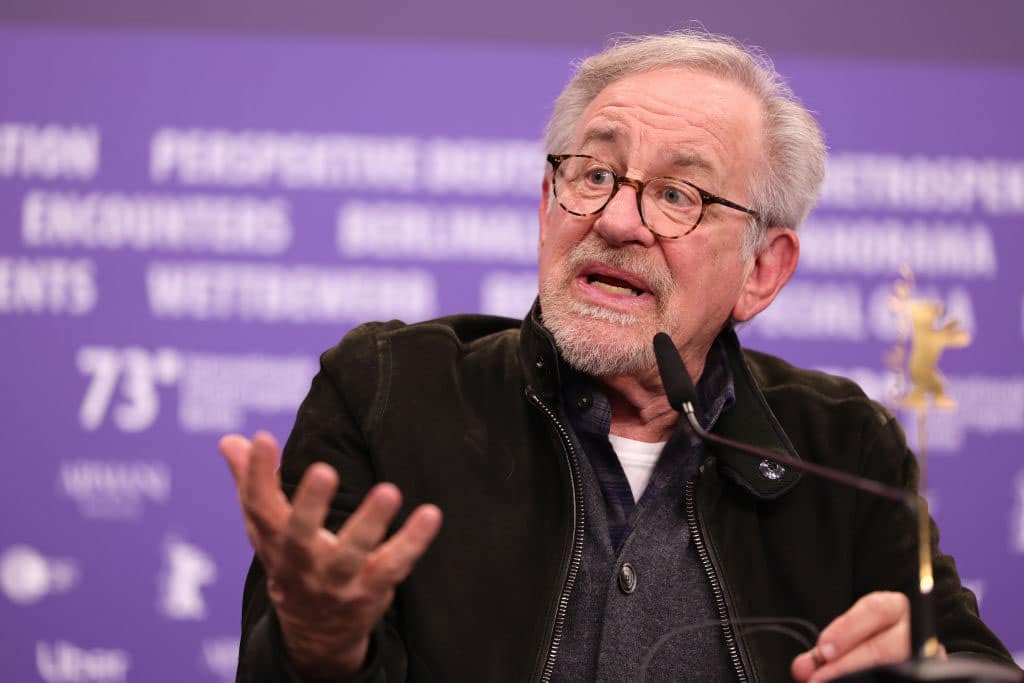
“I just know what it feels like to be overwhelmed with a desire to make a movie,” the director Steven Spielberg told the New York Times, giving a clue as to why he has two movies in theaters this holiday season.

Spielberg directed both the animated adventure “Tintin”, based on the bestselling European comic books by Herge, as well as the film adaptation of the play “War Horse,” which his producer, Kathleen Kennedy first saw on Broadway.

Two things struck me about this interview. First, when the reporter asked him the question about why he wanted to make “Tintin”, he basically said that he saw himself in the character.

I became enthralled with the way Hergé told his stories. Grand, epic, global adventures about a young reporter who goes all around the world looking for stories to tell and then gets himself deeply involved, and dangerously involved sometimes, in the stories he’s telling. And then eventually becomes the story itself. And I always related to that because I do the same thing. I go out and look for a good story to tell and if I like it enough and I decide to direct it, I become dangerously involved in becoming a part of that story.

The first thing that came to mind, of course, was “Schindler’s List,” which for Spielberg, became something of a permanent project. He invested heavily—both financially and otherwise—in creating The Shoah Foundation, a non-profit Holocaust memorial effort that cataloged visual histories of survivors. Holocaust preservation, subsequently, owes much to Spielberg’s personal connection.

Though his family-friendly fare is not every cinema-goer’s delight, that Spielberg himself is still ensorcelled by his vocation is kind of astonishing. Even at age 65 (which he became on Sunday), he still possesses the childlike wonder that attracted him to movies in the first place. And he isn’t afraid to try new things as “Tintin’s” experiment in form proves. “It made me more like a painter than ever before,” he told the L.A. Times last February.

The other bit I found both nostalgic and sweet was his admission that he runs a “mini-industry”—though he couches it in terms of community. It’s as if he works in an entirely different Hollywood than the one we’ve come to know, a cold-competitive corporate world that values profit above all. The way he puts it, Spielberg’s industry is a vestige of the way Hollywood used to be, preserved through the commitment of a devoted community.

[A]s an adult, filmmaking is all about appreciating the talents of the people you surround yourself with and knowing you could never have made any of these films by yourself.

My job was constantly to keep a movie family going. I’m blessed with the same thing that John Ford and Howard Hawks and Alfred Hitchcock were blessed with, a mini-industry very similar to the one from the golden era of Hollywood, where it was the same people making movies with you each and every time. And it makes life so much more enjoyable when you get to go home to your family and go to work with your other family.

It’s redundant to say, but how Jewish is that?

0 CommentsLeave your comment

December 20, 2011 | 1:03 pm

Christopher Hitchens and deathbed poetry

Posted by Danielle Berrin

Photo

I once had this fantasy that I would read a dying man poetry by his bedside. There would be low lights and rain trickling past the windowsill and it’s only now I realize how much I had glamorized a hospital scene. Death is not romantic so I thought I’d make it so. Poetry seemed, to me, the only way to get close to someone leaving, the consummate end to a doomed relation. It’s only now I realize our relations go on even after someone is gone. We all live with ghosts. The wilting flowers in the wooden box, mosaic hearts like shards of glass, the apparitions that haunt the doors at night.

I would’ve liked to have read poetry with Christopher Hitchens. But since I never knew him, well, at least not in the conventional sense (we all feel we know the writers we read) I’m grateful Ian McEwan was there, bedside, with Hitchens, piloting him through poetry into the world from which there’s no return. Least not according to Hitchens.

McEwan writes in The Globe and Mail:

In the afternoon I was helping him out of bed, the idea being that he was to take a shuffle round the nurses’ station to exercise his legs. As he leaned his trembling, diminished weight on me, I said, only because I knew he was thinking it, “Take my arm old toad …” He gave me that shifty sideways grin I remembered so well from healthy days. It was the smile of recognition, or one that anticipates in late afternoon an “evening of shame” – that is to say, pleasure, or, one of his favourite terms, “sodality.”

That must be how I came to be reading The Whitsun Weddings aloud to him two hours later…

I set the poem up and read it, and when I reached that celebrated end, “A sense of falling, like an arrow-shower/Sent out of sight, somewhere becoming rain,’ Christopher murmured from his bed, “That’s so dark, so horribly dark.” I disagreed, and not out of any wish to lighten his mood. Surely, the train journey comes to an end, the recently married couples are dispatched toward their separate fates. He wouldn’t have it, and a week later, when I was back in London, we were still exchanging e-mails on the subject. One of his began, “Dearest Ian, Well, indeed – no rain, no gain – but it still depends on how much anthropomorphizing Larkin is doing with his unconscious … I’d provisionally surmise that “somewhere becoming rain” is unpromising.’ 

And this was a man in constant pain. Denied drinking or eating, he sucked on tiny ice chips. Where others might have beguiled themselves with thoughts of divine purpose (why me?) and dreams of an afterlife, Christopher had all of literature. Over the three days of my final visit I took a note of his subjects. Not long after he stole my Ackroyd, he was talking to me of a Slovakian novelist; whether Dreiser in his novels about finance was a guide to the current crisis; Chesterton’s Catholicism; Elizabeth Barrett Browning’s Sonnets from the Portuguese, which I had brought for him on a previous visit; Thomas Mann’s The Magic Mountain – he’d reread it for reflections on German imperial ambitions toward Turkey; and because we had started to talk about old times in Manhattan, he wanted to quote and celebrate James Fenton’s A German Requiem: “How comforting it is, once or twice a year,/To get together and forget the old times.”

In Walter Pater’s famous phrase, he burned “with this hard gem-like flame.” Right to the end.

1 CommentsLeave your comment

December 19, 2011 | 5:23 pm

Against transformation: ‘Young Adult’, ‘A Dangerous Method’ and resistance to change

Posted by Danielle Berrin

Photo

In Khalil Gibran’s opus “The Prophet”, the story begins with a sage awaiting his ship—long has he been away from home. But when his ship arrives, the occasion is bittersweet; he knows he must journey forward and “return”—in Judaism, teshuvah, the ultimate spiritual act—and yet, he is deeply pained at what he is leaving behind.

Though he is divided in his heart, torn between two different places and two different selves, he knows that to stay is to die. It would be a spiritual death, a fatal malaise sprung from an inability to evolve. Hard as it may be, he has no choice but to take on the struggle:

“It is not a garment I cast off this day, but a skin that I tear with my own hands,” The Prophet says. “Yet I cannot tarry longer. The sea that calls all things unto her calls me, and I must embark. For to stay, though the hours burn in the night, is to freeze and crystallize and be bound in a mould.”

The central spiritual urge in Judaism is the possibility for transformation. We need not be whom we have been; the soul is meant to grow. The theme is universal, and the conflict between who we are and who we might be is sharply reflected in character tropes at the movies. The very formula for narrative arc, for instance, practically demands that a character changes. Isn’t it usually some kind of revelation that brings on the happy end?

But sometimes, art chooses the real over the ideal. And this year, two movies in particular—“Young Adult” and “A Dangerous Method” – undermine traditional character tropes by resisting the religious impulse towards change. The reasons vary: it’s too hard, there’s too much baggage, someone is too old. Sometimes, the revelatory moment comes – the ship sails into the harbor – but we are frozen in a mould and let it pass us by.

Mavis Gary, played flawlessly by Charlize Theron in “Young Adult” is a miserable grown up. She earns a living as a ghostwriter for a once-popular young adult series and lives a cozy urban lifestyle in a Minneapolis high-rise. The interior of her apartment is as messy and confused as her psyche. And night after night, she falls asleep in a drunken stupor, a cashed bottle by her bedside, as the pathetic plots on “Keeping Up With The Kardashians” play out in the background.

The two things she has going for herself are that she is beautiful and sad. She’s unhappy enough to be daring – she decides to return to her hometown to reclaim her happily-married high-school boyfriend, and vain enough to believe in her delusions – he will want her back, because she is rescuing him from his simple, small-town life.

It is worth seeing the movie to witness the stinging and snide tactics Mavis deploys – often distinctively feminine and boorishly funny—to achieve her goal. Her sabotage, of course, is a direct result of her self-pity, and so, the more desperately she tries to wrest her former flame away from his contented life, the closer she nears to utter breakdown. After all, it isn’t really him she’s after, but some younger, brighter version of herself.

Then comes the moment of truth. After wreaking havoc on everyone else, Mavis looks inward. “I have to change,” she says to the only person around who will listen. But because that person is so taken in by Mavis’s demonstrable gifts – her beauty, her brains, her exciting urban life – she reinforces all of Mavis’s basest beliefs about herself. Mavis is restored. Why do all that work when it’s simpler to be who she already is?

Obviously, change can only occur with will. But even if the motives are there, to what degree can a person alter their fundamental makeup?

That is the central question in “A Dangerous Method” in which Sigmund Freud and Carl Jung, the fathers of psychoanalysis (then, “the talking cure”) duke it out over just how much people can change. Is total transformation possible? Or is small, incremental change the best we can hope for? At the center of their dispute over the efficacy of psychoanalysis is a fundamental difference in worldview.

Jung is a man deeply tormented by his own sexual repression. He has chosen a profitable but loveless marriage and uses his work to work through his demons. He begins an affair with his patient, Sabina Spielrein, who fulfills his sexual and intellectual fantasies but is a blight on his family life—not to mention, a madwoman herself, whose sanity and stability teeters on the edge of safety.

Jung is a divided self. Near the end of the film, he tells Spielrein that his wife is the foundation of his home, his mistress is the perfume in the air, and that she is the love of his life. He is not seeking a workable solution to his complex problem; he is seeking redemption for his soul.

Freud, on the other hand, is foremost an academic, who avoids his own psychology by focusing on the psychology of his patients. He seeks to unmask the causes of repression, believing that a keener awareness might beget more self-control. His methodology relies on illuminating the grand psychoses so that their everyday manifestations (neuroses) become more manageable. 

Freud is a Jew. He’s seen too much. He knows the rhythms of history and how often, throughout, human beings resort to repeating patterns.

Jung, on the other hand, is not Jewish, but possesses the more religiously motivated belief system. He wants to know that transcendence is possible. That human beings can overcome the traumas that shape them and reinvent the contours of their lives. Spielrein, ironically, becomes his emblem: She overcomes mental illness, survives their affair, marries and has children, and establishes herself as a prominent voice in the psychoanalytic community. Then, the cruelties of fate intervene and she is murdered by the Nazis.

So much for transformation.

The precipice of change is a narrow bridge. And in the movies, as in life, it is difficult to cross without fear. Though the great sage, Rabbi Nachman of Bratslav tells us to do precisely that: “The important thing is not to fear at all.” Judaism tells us that to live statically is to live slightly. Our souls should always be striving, journeying towards the place of promise, no matter how bewildering, exhausting or frightening the desert years.

There will always be arriving ships for souls adrift. Hearts will always be torn between differing desires. “[W]ho can depart from his pain and his aloneness without regret?” The Prophet asks. Leaving behind who you are in order to become who you’re meant to be is a task for the brave. It cannot be faked – even in the fictional world of movies.

0 CommentsLeave your comment

December 15, 2011 | 10:38 pm

Wisdom from ‘The Wizard of Oz’

Posted by Danielle Berrin

Photo

The Wizard to Tin Man: “As for you my galvanized friend, you want a heart? You don’t know how lucky you are not to have one. Hearts will never be practical until they can be made unbreakable.”

Tin Man: “But I still want one.”

0 CommentsLeave your comment

December 15, 2011 | 12:24 pm

Golden Globes: The Jewish Nominees

Posted by Danielle Berrin

Photo

The 69th Annual Golden Globe Award Nominations were announced early this morning and for those who want tribal highlights, here goes…

In the film categories:

Woody Allen leads the pack with his box-office hit “Midnight in Paris” with three nominations for Best Screenplay, Best Motion Picture Musical or Comedy and Best Director.

Jonah Hill and Albert Brooks will go head-to-head in the category of Best Supporting Actor for their respective performances in “Moneyball” and “Drive”.

Steven Spielberg picks up nods for “Warhorse” (Best Motion Picture Drama) and for “The Adventures of Tintin” (Best Animated Feature Film).

Aaron Sorkin gets a screenplay nod for “Moneyball” which he co-wrote with Steven Zaillian.

In Television:

Showtime’s “Homeland” based on the Israeli format “Prisoners of War” and produced by “24’s” Howard Gordon gets a nod for Best Television Series - Drama and acting nominations for its stars Claire Danes and Damian Lewis.

HBO’s “Game of Thrones” created by David Benioff and D.B. Weiss also gets nominated in the Best Television Series category.

“Modern Family” created by Steve Levitan and Christopher Lloyd (married to a Jew) is nominated for Best Television Series Comedy or Musical in addition to acting nods for Sofia Vergara and Eric Stonestreet.

HBO’s “Too Big To Fail” which features the beloved Jews of Wall Street gets nominated for Best Mini-Series or Motion Picture Made for TV.

Evan Rachel Wood is nominated for her supporting performance in HBO’s “Mildred Pierce” mini-series.

And in case you want to check out George Clooney’s four nominations, you can read the full list at Deadline.com

1 CommentsLeave your comment

December 14, 2011 | 6:15 pm

Angelina Jolie and genocide beyond the Holocaust

Posted by Danielle Berrin

Photo

Photo by REUTERS/Mario Anzuoni

Even the title of Angelina Jolie’s film, “In the Land of Blood and Honey” suggests parallels to the Jewish story.

It bespeaks the location of one genocide, where the ethnic cleansing of Bosnian Muslims by Christian Serbs took place, while doubling as a reference to the land of milk and honey, which was not host but haven for Jewish victims of a different genocide.

But Jolie’s film also proves that genocide is not exclusive to the Holocaust. According to Anne Applebaum, writing in The New York Review of Books, the actual word “genocide” was coined in 1943 when Polish-Jewish lawyer Raphael Lemkin needed a way to describe “the crime of barbarity” that Adolf Hitler and the Nazi regime were imposing throughout Europe. Though history has proven the word contains multitudes, and encompasses a horror more prodigious than a singular event.

Though I have not yet seen the film, Jewish Journal executive editor Susan Freudenheim did, and came away with a poignant message about a powerful film: That the xenophobia and tribalism that impels one group to brutalize another is evident across cultures and a more pervasive evil than any single conflict.

Freudenheim writes:

I left this film thinking of its similarities to the Holocaust. And then I immediately ran into a friend, Samuel Chu, an activist born in China, who told me he’d come to see “Blood and Honey” just after watching “City of Life and Death,” by the Chinese director Lu Chuan. That film is about the 1937 Nanjing Massacre — also known as the Rape of Nanjing — when the invading Japanese brutalized the Chinese. Chu said he was deeply moved by the parallels between “Blood and Honey” and China’s story.

And then there are the parallels to the current situation in Darfur, where women continue to be brutalized just for leaving their camps to gather firewood.

And there were yet other parallels, as “Blood and Honey” lead actor Goran Kostic pointed out: As the conflict in Bosnia-Herzegovina played out, Steven Spielberg was in Poland shooting “Schindler’s List,” a recreated ethnic cleansing only a short distance away from an existing one.

Even beyond ethnic annihilation, Jolie’s film also addresses the tyranny of men over women, and the barbaric savagery that ensues when men are powerful and women are vulnerable.

Read Freudenheim’s rave report here

1 CommentsLeave your comment

Page 1 of 5 pages  1 2 3 >  Last ›


About this Blog

Blog Home
About the Blogger(s)
Contact

RSS


Blog Archive


Newspaper

Serving a community of 600,000, The Jewish Journal of Greater Los Angeles is the largest Jewish weekly outside New York City. Our award-winning paper reaches over 150,000 educated, involved and affluent readers each week. Subscribe here.

© Copyright 2013 Tribe Media Corp.
All rights reserved. JewishJournal.com is hosted by Nexcess.net. Homepage design by Koret Communications.
Widgets by Mijits. Site construction by Hop Studios.

counter fake hit page