Quantcast

Search our Archives!


Advertisement


Hollywood Jew

November 30, 2011 | 2:08 pm RSS

Does ‘Curb Your Enthusiasm’ have something to teach Bibi Netanyahu?

Posted by Danielle Berrin

Photo

Harvard law professor Alan Dershowitz thinks so.

In fact, he told the Jewish-themed Columbia University magazine “The Current” that he recently sent the Israeli Prime Minister a DVD of the famed Palestinian Chicken episode that aired early last summer.

A conversation that began in politics and policy eventually turns toward Hollywood:

Current: One last question: what’s your favorite Woody Allen movie?

Alan Dershowitz: Well, I met Woody Allen while he was filming Manhattan. He was given to me as a 40th-birthday present by friends. He agreed to have lunch with me, and we became, I wouldn’t say friends, but we became acquaintances from that time on. Since I was there while he was filming Manhattan, I think Manhattan has always been my favorite. And if you want to ask me what my favorite Larry David episode is…it’s “Palestinian Chicken.” And let me tell you this: I recently sent a copy of “Palestinian Chicken,” that Larry David gave me, to Prime Minister Netanyahu—with the suggestion that he invite Abbas over to watch it together. And maybe if they both get a good laugh, they can begin a negotiating process.

Current: Do you know if that happened?

AD: I don’t know, but I know that Netanyahu has received the DVD, and he was looking forward to watching it. So it may be that Larry David will not only win Emmys, but he may even qualify for the Nobel Peace Prize, if his episode could bring together Netanyahu and Abbas, and bring Abbas to the negotiating table.

When I emailed, Robert Weide, the director of the Palestinian Chicken episode (and the producer of a recent PBS American Masters documentary on Woody Allen, the subject of a Jewish Journal cover story), he pointed out that the episode contains some pretty profane vulgarities some might call anti-Semitic (uttered by anyone other than Larry David, count more in that camp). Worse comes to worse, in case Netanyahu didn’t get the self-deprecating gene, at least Abbas will like it.


The Jewish Journal believes that great community depends on great conversation. So, jewishjournal.com provides a forum for insightful voices across the political and religious spectrum. Most bloggers are not employees of The Jewish Journal, and their opinions are their own. Our entire blog policy is here. Please alert us to any violations of our policy by clicking here. (editor@jewishjournal.com). If you'd like to join our blogging community, email us. (webmaster@jewishjournal.com).

November 30, 2011 | 1:17 pm

Mayim Bialik narrates for chained women

Posted by Lauren Bottner, Hollywood Jew contributor

Photo

Mayim Bialik narrates a film about 5 agunot, “chained women who are unable, according to Jewish law, to remarry until they receive a get.” reported the Jewish Week.

The film tells the story of these 5 American women, four of whom eventually get a get.

The documentary will be showed at the Palm Beach Jewish Film Festival on Dec. 14, and as Bialik posted on facebook, “It’s very interesting (i think).”

For past coverage on Bialik, visit the Jewish Journal:
Religion blossoms for Bialik
A Green Jew Mama: Q&A with Mayim Bialik
‘Big Bang Theory’ Actress Lives at Intersection of Science, Religion

0 CommentsLeave your comment

November 30, 2011 | 1:12 pm

Ronni Chasen murder becomes comic strip

Posted by Danielle Berrin

Photo

A dashing blonde. A fancy car. A movie premiere followed by a midnight murder...

A cartoon sketch?

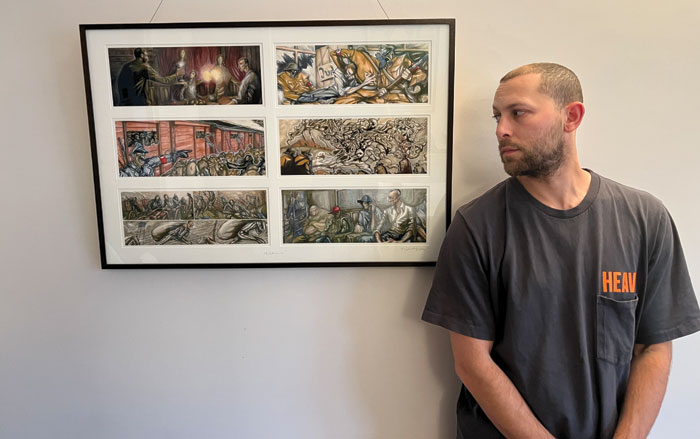
In a very odd memorial tribute to the murdered publicist Ronni Chasen, who was killed in Beverly Hills while driving home from a movie premiere more than a year ago, arts meme blogger Debra Levine has posted a cartoonish sketch rendering of the murder story that gripped a nation. Artist Benoit Le Pennec drew a series of sketches depicting the chain of events leading up to the Chasen murder—not in the noirish style of the events as they really happened, but as a kind of trippy comic book storyboard: There’s the murderous gun-toting bicyclist blowing the smoke out of his gun, with his big puffy cheeks, while Chasen’s car smokes after its crash into a tree. 

Levine’s instinct to spotlight a re-telling of the story makes sense—it was the most spellbinding crime of the year. And she aptly refers to it as an “exquisite, undiluted brand of L.A. noir…gripping, priceless, stranger than fiction” but its darkness and iniquity are diluted in caricature. A stormy graphic novel full of color and terror would have been more mystifying in movie-land.

1 CommentsLeave your comment

November 30, 2011 | 1:02 pm

Could Katy Perry play Marilyn Monroe?

Posted by Lauren Bottner, Hollywood Jew contributor

Photo

Harvey Weinstein wants to turn his new film “My Week with Marilyn” into a Broadway musical starring the bubblegum-songstress Katy Perry.

According to Perez Hilton, Weinstein reportedly said:

“If the movie works, I would try to make it a musical and I would go to Katy first. I think she can play Marilyn on the Broadway stage. I think she would be amazing. Katy posted about [the movie] on her Twitter and Facebook and the next thing you know 250,000 people have downloaded the trailer in an hour.”


0 CommentsLeave your comment

November 29, 2011 | 4:28 pm

Tony Kushner awarded $100,000 prize for challenging status quo

Posted by Danielle Berrin

Photo

Who said great artists must starve? Tony Kushner, the Pulitzer Prize-winning playwright and screenwriter, and polarizing political voice, will be awarded $100,000 for “Creative Citizenship” at The Nation Institute’s Annual Gala on Dec. 5 in New York.

The award, co-sponsored by The Puffin Foundation and The Nation Institute, both organizations of particular social conscience, is designated for those who have “challenged the status quo through distinctive, courageous, imaginative, and socially responsible work of significance.” 

In a press release announcing the prize, the organizations explained their choice thusly:

[Kushner has] given voice to the marginalized and explored the most challenging issues of the past fifty years. He has tackled everything from AIDS and the conservative backlash (Angels in America), and the civil rights movement in the South (Caroline, or Change), to Afghanistan and the West (Homebody / Kabul), and the rise of capitalism (Hydriotaphia, or the Death of Dr. Browne). As John Lahr wrote in the New Yorker, “He gives voice to characters who have been rendered powerless by the forces of circumstances — a drag queen dying of AIDS, an uneducated Southern maid, contemporary Afghans — and his attempt to see all sides of their predicament has a sly subversiveness. He forces the audience to identify with the marginalized — a humanizing act of the imagination.”

A closer look at the sponsoring organizations’ social missions indicates Kushner is being recognized for more than work alone. Independent of his art, Kushner is known for his daring political views, especially as they concern Israel. He is outspoken about his philosophical struggles with the Israeli-Palestinian conflict, which he outlined in the book, “Wrestling with Zion,” a compilation he edited that showcases progressive Jewish-American attitudes towards Israel.

In 2007, Jewish Journal Publisher and Editor-in-Chief Rob Eshman interviewed Kushner on stage at American Jewish University, where he asked Kushner about his Jewish identity and relationship to Israel. In a follow-up editorial, Eshman wrote:

Kushner embraces uncertainty. “I have very mixed and complicated feelings about the state of Israel as a Jewish American,” he said on Monday evening, “and I’m furious at being represented as this kind of marginal crazy who’s plotting to destroy the state of Israel. I think everybody harbors their own secret doubts, or at least most of us do, and everybody’s afraid to say them, because the orthodoxy is policed with such violence and vituperation.”

Kushner and director Steven Spielberg endured a wave of criticism from some within the Jewish community who felt their film “Munich” stretched too far in trying to humanize Palestinian terrorists, or in trying to insert moral quandary into the minds of Israelis assigned to kill those terrorists.

I asked Kushner why [playwright David] Mamet, among others, finds his position so unpalatable. “It’s because they’re trying to defend the indefensible,” Kushner said. “It’s trying to uphold the reality you can’t uphold. It’s a cartoon version of Middle Eastern politics that almost no one in the state of Israel recognizes. There’s easily 50 percent of the Israeli population that’s progressive.”

I’m not sure of that number, especially in the wake of the Hamas takeover of Gaza, but Kushner was clearly still feeling the sting of “Munich.”

“I can’t feel neutral about the state of Israel because I’m a Jew,” Kushner said, “and I would like to see Israel survive and prosper. I absolutely don’t believe in single-state solution. I believe in a two-state solution. I’ve never anywhere on earth said I believe Israel should be forced to give up its identity as a Jewish state ... that obviously wouldn’t work. It would be the end of Israel.”

Kushner’s willingness to challenge mainstream opinion on Israel has earned him the ire of more conservative Jewish minds. His outspokenness on the issue, he has said, has sometimes led to mischaracterization of his beliefs. Last May, a public debacle ensued when the trustees of the City University of New York (CUNY) voted to rescind an honorary degree intended for Kushner when a board member objected on account of his views on Israel. An outraged public, which provoked scores of media coverage and a pro-Kushner op-ed in the New York Times, helped to reverse the decision.

In this case, however, it is precisely Kushner’s “unorthodox” views that won him the recognition. The Puffin Foundation is devoted to minority and marginalized artists, and provides artist grants to individuals and organizations working on the fringe (in their words: those “excluded from mainstream opportunities due to their race, gender, or social philosophy”) which coheres with Kushner’s intense focus on civil rights. Likewise, The Nation Institute, a non-profit media organization that promotes progressive ideas (among their online and print publications is The Nation magazine), syncs well with Kushner’s liberal politics. Upon learning of the award, Kushner said, “Like most progressive Americans, I depend on The Nation magazine for serious, scrupulous, courageous reportage and analysis; I’m very proud to have been published in its pages and proud of my association with The Nation Institute.”

He added: “To be a good citizen, much less a creative one, is a tall order, and while I hope I can say I’ve never taken the blessings of citizenship (however abridged these remain, despite recent advances, for the entire LGBT community) for granted, I feel certain that I’ve achieved at best a rudimentary level of sufficiency regarding the obligations that come with the franchise. I can only add that since this will make me feel terrible every time I fail to be a creative citizen, it’ll be a goad to step up my game — since citizenship, like playwriting or the violin, requires practice, practice, practice.  I’m so grateful to The Institute and the Puffin Foundation for their wayward taste and misguided judgment, and I plan to keep blushing for several years to come.”

According to the release, Kushner is the 12th recipient of the prize. Past honorees have included the environmental activist Van Jones, human rights lawyer Michael Ratner, “Nickel and Dimed” author Barbara Ehrenreich, professor and anti-death penalty advocate David Protess and labor activist Dolores Huerta.

0 CommentsLeave your comment

November 29, 2011 | 12:35 pm

Scarlett Johansson: Kenyans and Americans all want to work

Posted by Lauren Bottner, Hollywood Jew contributor

Photo

Scarlett Johansson took time from her movie-star day job to speak with Arianna Huffington about poverty and her commitment to making the world a better place. 

“There are people in America who are absolutely desperate right now, who have no means to support their families, who have no opportunities to better themselves or their education—and they’re not that different from the farmers and working-class people that I visited when I went to Kenya with Oxfam,” she said.
“Whether they’re in America or in Africa, people want to work,” she continued. “They want to have purpose.

The actress is currently working on Cameron Crowe’s “We Bought a Zoo” which Johansson co-stars in with Matt Damon.  The movie comes out December 23, 2011.


0 CommentsLeave your comment

November 29, 2011 | 12:26 pm

Anne Hathaway’s plan spoiled by love

Posted by Lauren Bottner, Hollywood Jew contributor

Photo

Actress Anne Hathaway is now sporting an engagement ring from her boyfriend Adam Shulman whom she’s been seeing since 2008 reports PEOPLE.

“I am very much in love with him, [only] Adam totally ruined my plan,” Hathaway, 28, previously said of their three-year relationship. “I was really actually looking forward to a little alone time, and then I fell in love like a fool!”

0 CommentsLeave your comment

November 28, 2011 | 5:49 pm

Harvey Weinstein plays to Hollywood’s nostalgia with ‘The Artist’

Posted by Danielle Berrin

Photo

The Academy should have an Oscar honor named for Harvey Weinstein, the mega-producer whose name has become synonymous with “Oscar” and who is widely credited for transforming the way campaigns are played.

Thus far this year, Weinstein’s Oscar buzz is coming in the form of the black-and-white silent-era homage, “The Artist” which screened before a group of Academy voters last Monday night, reports Michael Cieply in The New York Times.

An audience packed with awards season voters heard Mr. Weinstein tell how even his brother Bob, a partner in the Weinstein Company, thought he was crazy to risk “a lot of millions” on a black-and-white valentine to Los Angeles, and to the movies, and to an industry that was packed into the Academy’s own theater to see what the mogul behind last year’s best picture, “The King’s Speech,” had wrought.

If they gave an Oscar for best campaign moment, Mr. Weinstein could have taken his home that night.

Weinstein can sometimes be more entertaining than his movies. He has a way of upstaging his product with his popularity; his legend—some of which radiates, some of which repulses—is a presence that infuses everything he does. In some sense, Weinstein is The Artist he’s promoting. And it is precisely that egocentric approach to campaigning may prove fortuitous for “The Artist,” which, as Cieply suggests, appeals to Hollywood’s sense of itself.

Hollywood’s professional Oscar campaigners — who generally do not discuss their craft publicly, for fear of diminishing its effect — are privately buzzing about Mr. Weinstein’s bid to outmaneuver films that are bigger, broader and better positioned for the general audience. He is doing that by playing to the movie industry’s wobbly sense of self, exactly at a time when it is fretting about declining attendance, weak economics and constant pressure from other media.

In other words, pump them up with nostalgia. Reminding Oscar’s eldest elders of the way things used to be, especially at a time when those things seems to be fundamentally changing or dying out altogether, may prove an effective tactic at winning one. But the appeal of the past carries more weight than the eight-and-half-pound statue Weinstein could add to his collection.

As A.O. Scott wrote in a recent Times think piece, movies are by nature, objects of nostalgia. They are things of the past; by the time we watch the scene playing out before us, it has already happened.

[T]here is also something about cinema’s essentially modern character that makes it vulnerable to fears of obsolescence. The camera has an uncanny ability to capture the world as it is, to seize events as they happen, and also to conjure visions of the future. But by the time the image reaches the eyes of the viewer, it belongs to the past, taking on the status of something retrieved. As for those bold projections of what is to come, they have a habit of looking quaint as soon as they arrive.

Nostalgia, in other words, is built into moviegoing, which is why moviegoing itself has been, almost from the beginning, the object of nostalgia.

A spate of recent articles have explored dying mediums—the death of movies, the death of the sitcom. The general complaint being, they don’t make ‘em how they used to. Part of that is a product of the times and changes in technology, and part of it, I suspect, is a lost ingenuity in filmmaking that has become so greatly overshadowed as an artistic medium by its commercial possibilities.

For the Academy itself, it represents a confrontation with mortality. Hollywood is not what it once was (and neither are they) because the industry is older. In some ways it is better and wiser, in other ways, it begs for a youthful rediscovery—a Harvey Weinstein passion for all the sight, sound and story possibilities that made film so wondrous in the first place.


0 CommentsLeave your comment

Page 1 of 6 pages  1 2 3 >  Last ›


About this Blog

Blog Home
About the Blogger(s)
Contact

RSS


Blog Archive