Advertisement
Posted by Melanie Reynard
“Everyone likes someone who is good at telling stories,” a friend once observed to me years ago. Tonight with Ira Glass on stage, it seems to be true.
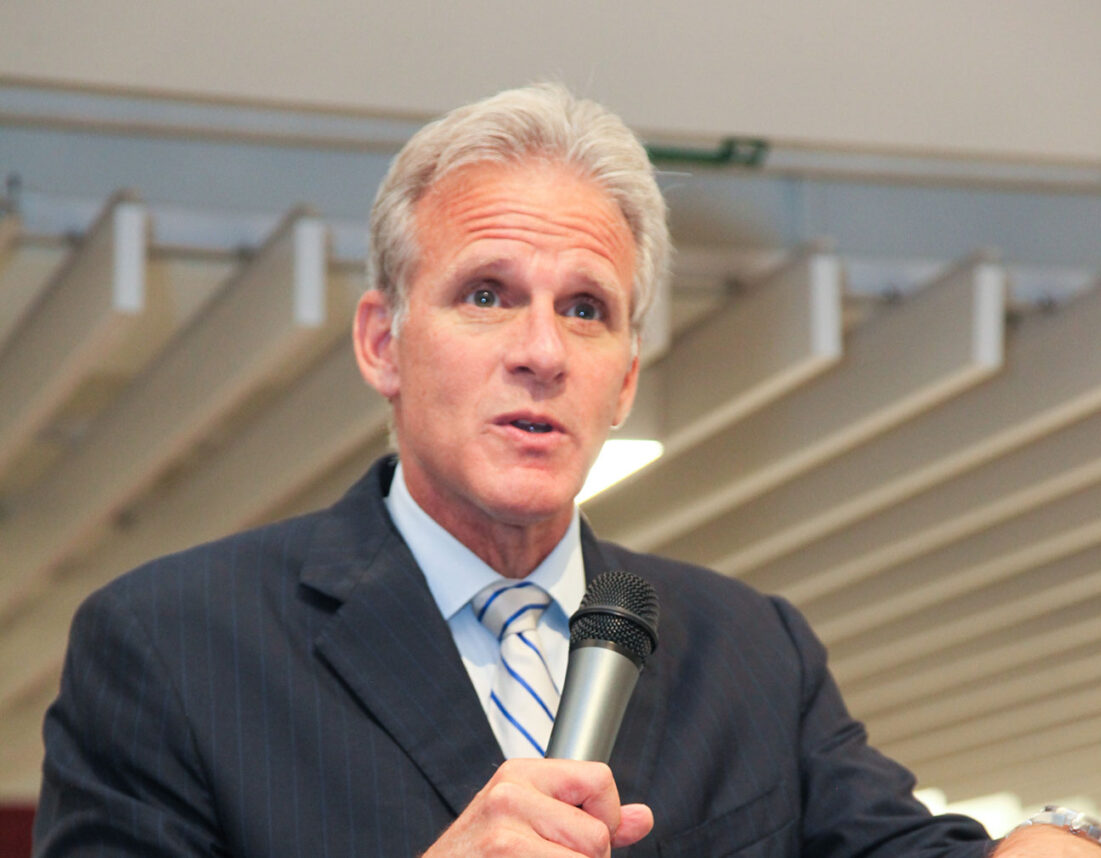
It’s 6:20 PM, and Ira Glass is re-cutting the opening for our 7:00 PM show. He’s on stage at UCLA’s Royce Hall, about to do a show presented by KCRW called “A Night with Ira Glass: Radio Stories & Other Stories.” He is on stage, behind a desk with a laptop and soundboard, surrounded by a hive of swarming reporters.
Glass maintains an aura of informality, as if he is in production with each of us, even while we are a sea of unidentified journalists. A curly-haired young radio reporter stands tepidly by him. Glass takes the microphone to hold it himself: “I can’t stand bad mic placement.” A photographer inadvertently stands in front of a row of other photographers when he asks Ira Glass a question, and before answering the question Glass cautions, “You’re in their shot.”
This sense of offhand conversation carries into the actual show. Even while I sit in a black sea of an anonymous crowd, I have to remind myself that Ira Glass is not talking to just me, in a coffee shop, while he also happens to be tinkering with his production equipment. I also have to take a mental step back to notice that Glass continues to be saturated in the theme of storytelling to a meta-degree. He is a professional storyteller, and tonight he tells stories to demonstrate the developed craft of storytelling. He never seems to be reading from a script. Rather, he seems to be transparent in all that he does – even telling us that he plays audio clips from interviews off his laptop on the right, while on the left he plays from a music player. He stammers, mid-story that takes place in Florida, to ask us to help him quickly clarify whether it is “Palm Beach, or Palm Springs?” that he is referring to, and then he taps the laptop with an exaggerated sweep of the right arm, as if he were plucking a high piano note.
He has prefaced this evening with the definition of “story” as a sequence of actions. What draws us into stories is that as an audience we feel motion toward a place - a destination. He makes us see his reins; a raconteur lures us with the hungry desire to know where the story is going – “where are you going?” we are brought to think, as we listen in suspense. He recalls High Holy Days services with his family Maryland when he realized that the rabbi’s captivating sermon parallels his own structure of storytelling.
Glass carries on with this transparency by giving us, offhand, a few tricks of the trade. For example, as a radio interviewer he tries to provoke people to recount dialogue, such as “He says…she says…” which is just as good as capturing the action in real-time.
Toward the end of the performance, which really seems more like a conversation (except, oh, right, only Ira Glass is doing the talking), Glass explicitly comes to the crux of his thesis. The psychological building blocks of what makes a person, he says, is the ability to see into another person’s perspective. He says in an age when we’re bombarded by narrative (advertisements, texts, etc.), it is rare that the mainstream news media makes us feel that we have seen inside another person’s perspective. Those moments of seeing, of insight, however, are sacred because they make us feel less harried or blinded or unconscious, or as Glass puts it, “make us feel less crazy.” In our productive, industrial culture, people are expected to innovate and create, but Glass points out, “No one talks about where ideas come from. Ideas come from other ideas.” And ultimately, when Glass bites the meat of why stories are important, his voice slows down. With a somber tone, he cites that “irrational” and “deep” part of us. Then, he leaves us with a haunting pause. Glass really seems to be showing and telling his point at the same time.
The house lights go up, and we flow seamlessly into the Q&A finale. Much of the audience seems fascinated by this nerd behind the desk on stage. A man from the balcony asks if Glass recites stories incessantly, like when he comes home and has dinner with his family. A girl from the back of the auditorium asks Glass for tips on getting an internship. That man in the spotlight seems to shine with a quaint and quirky celebrity – for this evening we’ve all been in conversation with him yet we want MORE -
We want to know what he’s like at home, we want to know how to get a job with him, we want to… BE him? Is there something so alluring about being a conductor behind a desk with human voices, music, and witty reflection at his disposal? There are many people who can talk our ear off, but we don’t want to be them. But this chatty DJ has drawn a following because he can deftly command human voices from the sound speakers (people talking about their mother’s ashes or their summer jobs), and then remix it with an ironic jingle or harrowing crescendo. We’re on the edge of our seats as if to ask, “Where are you going?”
Imagine: like Ira Glass, you are an American, wearing the conventional drab gray business suit, at the office. Suddenly your cubicle disintegrates. A stage is revealed – and your desk is in the spotlight, before a sea of a large, friendly audience. You become your own DJ, with a soundtrack of your life ready at the player on your left. And from the laptop on your right, you scratch and spin recordings from conversations, eavesdropped snippets, recounting of quotidian memories.
And won’t it be a glorious moment, when instead of having to ask someone else, “Where are you going?”, you’re the one with the answer.

5.22.13 at 9:09 am | Eric Garcetti became the first elected Jewish. . .

5.22.13 at 8:16 am | UPDATE 8:00 am: Eric Garcetti wins the mayoral. . .

5.21.13 at 11:06 am | Using his preternatural smoothness, Justin. . .

5.20.13 at 11:40 am | Proving once again that there isn’t anything he. . .

5.14.13 at 9:59 am | This week on his podcast, Jewish comedian Marc. . .

4.30.13 at 10:58 am | Michael Diamond (Mike D.) and Adam Horovitz. . .

4.24.13 at 3:15 pm | So, 17-year-old Milken Community High School. . . (1680)

4.25.13 at 4:47 pm | (525)

5.22.13 at 8:16 am | UPDATE 8:00 am: Eric Garcetti wins the mayoral. . . (427)


March 23, 2010 | 10:45 pm
Posted by JewishJournal.com

From LA Magazine:
[LA Magazine’s] GetL.A. contest invites readers to show the world—via a three-minute video—what it’s like to live in our city. In partnership with the nonprofit volunteer action group L.A. Works, the magazine is sponsoring this online short film competition to start a citywide dialogue. The public will vote for an “Audience Favorite,” and a panel of notable Angelenos will choose the “Official Selection.”
It took multiple screenings, four bags of popcorn, a gallon of root beer and some heated debate, but we did it: We narrowed down the smart, funny, thoughtful and thought-provoking Get L.A. submissions we received in our first-ever short-film competition to these eight finalists.
Watch them here, then vote for your favorite between now and 11:59:59 p.m. on April 1. The finalist with the most votes will be named Get LA’s “Audience Selection.”
March 23, 2010 | 2:14 pm
Posted
By Ami Eden and Edmon J. Rodman
The following round-up is adapted from JTA’s Passover blog, blogs.jta.org/passover:
Helping interfaith families navigate Passover
The Jewish Outreach Institute has launched a “Preparing for Passover” blog. The catch: It features women from other religious backgrounds who are raising Jewish children.
One contributor identified as Elizabeth took to the blog to recall her spring situation from last year:
“My parents live 800 miles away, and wanted to come spend Easter with the kids. We don’t celebrate it, but anytime they want to come and under whatever context, that’s fine. The problem—they were scheduled to arrive at four on the afternoon of the seder. While I would be making my four dishes for the dinner, getting dressed up and dressing the kids, stowing the spare chairs and tables in the car, getting our ritual objects out of the attic, rehearsing the four questions with my youngest. But really, it wasn’t the logistics that bothered me. It was whether to invite them. Invite them to an event that would be held half in Hebrew, three hours long, after two days of driving, with people they don’t know and rituals that they had their own Christian interpretations for? I didn’t really want to spend my seder being the explainer, holding everyone and everything together and feeling all of that stress myself. ...
“[Eventually] I sucked it up, decided I could handle this and invited them. But they didn’t come—it was Holy Week and they wouldn’t miss going to church that night. Duh. Another interfaith religious dilemma solved itself here in my little corner of the tent.”
If any one out there is facing a similar situation this year, Levi Gibian Fishman of the Jewish Outreach Institute has put together a list of tips for conducting an “inclusive interfaith seder.” One of his suggestions: honor the newcomer.
“Go further than merely acknowledging the newcomers sitting around your seder table,” he wrote. “Let them know their presence is truly a blessing. By choosing to partake, the newcomers are aligning themselves with the Jewish community and casting their lot with the Jewish people. Vocalize your appreciation during the seder by expressing how thankful we are for their participation.
Twittering the plagues
Stephanie Simon and Ann Zimmerman of The Wall Street Journal reported on Rabbi Oren Hayon’s innovative initiative: Passover twittering.
“Building on a growing movement to add a bit of fun to the plagues and pestilence, he has recruited a handful of fellow rabbis to act out the Passover story in 140-character Twitter messages, accessible at twitter.com/tweettheexodus.
“The drama began [March 16] with a link to a trailer for the 1956 film ‘The Ten Commandments’ followed by @The_Israelites complaining: ‘We have much to fear from @PharaohofEgypt. He tires of us… ’ The improvised dialog will continue for two weeks.”
Keep it simple
That’s the main piece of advice from Tamar Fox of MyJewishLearning: “When Passover approaches, it seems like everyone in the Jewish community goes a little bit (or more than a little bit) crazy. You start hearing about people going through every page of every book in their house, trying to eliminate miniscule crumbs. Kosher stores are clogged with families inspecting the new Passover friendly products, and elaborate Passover recipes are getting passed around, each of which seems to call for potato starch, and 7 egg yolks.
“If you’re into that, go for it. But if you don’t have an endless supply of time and money to buy and cook for Passover, then let me give you my foolproof Passover food tip: Chill out, and go as simple as possible. You do not need a kitchen full of new supplies, a full slew of kosher for Passover spices, or a new cookbook to get you through the week of Passover. In fact, you need the opposite. Strip it all down to the bare minimum.”
Matzah balls and strikes
Matzah balls won’t be the only spheres being served up on Passover—the Major League Baseball season opener is on April 4: Mariners vs Giants and Yankees vs Orioles. But what to eat if you’re going to the game? A hot dog on matzah? There’s a great children’s book (ages 5-9) on just this theme, “Matzah Ball: A Passover Story,” by Mindy Avra Portnoy and Katherine Janus Kahn.
Seder rations
Need a seder that’s ready to go and ready to eat? Here’s one all individually packaged. What’s the catch? To order it you need to be in the U.S. Armed Services. Served up by the Defense Services Agency, each ration includes 1 disposable seder plate, 8 packets of horseradish, 2 cans gefilte fish, even 1 white yarmulke, and much more packed in a white recloseable sturdy box. (Sorry no wine, but there’s juice.) Order early.
Hillary plays Exodus card
The U.S. secretary of state, Hillary Rodham Clinton, ended her speech at the AIPAC conference with a Passover flourish.
“We are entering the season of Passover. The story of Moses resonates for people of all faiths, and it teaches us many lessons, including that we must take risks, even a leap of faith, to reach the promised land. When Moses urged the Jews to follow him out of Egypt, many objected. They said it was too dangerous, too hard, too risky. And later, in the desert, some thought it would be better to return to Egypt. It was too dangerous, too hard, too risky. In fact, I think they formed a back-to-Egypt committee and tried to stir up support for that. And when they came to the very edge of the promised land, there were still some who refused to enter because it was too dangerous, too hard, and too risky. But Israel’s history is the story of brave men and women who took risks. They did the hard thing because they believed and knew it was right. We know that this dream was championed by Herzl and others that many said was impossible. And then the pioneers - can you imagine the conversation, telling your mother and father I’m going to go to the desert and make it bloom. And people thinking, how could that ever happen? But it did.”
March 18, 2010 | 3:44 pm
Posted by Rebecca Steinberger
Rick Hyman was inspired to paint his family history when he found 300 black and white photos from the early 1900s in a relative’s drawer. Hyman and his wife, Ronda, interpreted their experience into a book, “My Texas Family: An Uncommon Journey to Prosperity.”
Last fall, Hyman taught students at Taft High School, the Woodland Hills Academy and the New Community Jewish School in the Valley, and Fremont High School in South L.A. how to research their heritage. The project, “An Uncommon Journey to Diversity” was displayed at the Jewish Community Center at Milken in West Hills. Their paintings expressed family and cultural traditions through art.
Video by Rebecca Steinberger
March 17, 2010 | 3:26 pm
Posted by Rob Eshman

The furor that’s erupted between the U.S. and Israel following Israeli PM Benjamin Netanyahu’s decision to build 1,600 new apartments in a portion of East Jerusalem has is only made worse by the astonishing lack of accurate information circulating over the international legal status of Jerusalem. To whom does it belong? Who has a right to build there? Who recognizes that right? The worst way to answer that question is to read the op-ed pages, where each side advances its arguments as facts. And when it comes to arguments, few engage as many deep emotions as Jerusalem.
For instance: We just received a press release from B’nai B’rith Canada condemning the “disparaging” remarks of a Canadian minister who criticized Israel’s buiding in East Jerusalem as contrary to international law. Here it is:
B’nai Brith Canada has expressed disappointment at remarks Foreign Minister Lawrence Cannon made yesterday at the House of Commons foreign affairs committee condemning Israel’s plans to build new apartments in a Jewish neighbourhood of East Jerusalem. At the committee, FM Cannon “condemned” the Israeli decision and said that it is “contrary to international law.” Since 1967, Israeli governments across the political spectrum have consistently expressed sovereignty over the entire city of Jerusalem. Israeli Prime Minister Netanyahu’s decision to freeze building for 10 months was limited to Judea and Samaria, and specifically did not include East Jerusalem.
“Jerusalem has been, and always will be, the historical, national, and religious capital of the Jewish State,” said Frank Dimant, B’nai Brith Canada’s Executive Vice President. “We regret Minister Cannon’s remarks condemning Israel’s decision to build in its capital.
“We are confidant [sic] that the Foreign Minister’s disparaging remarks do not in any way reflect a shift in the Government’s principled position with respect to its Israeli ally.”
Here’s the thing: the minister’s comments were precisely in keeping with Canadian—and international—law. Here is Canada’s official policy regarding Jerusalem:
Status of Jerusalem
Canada considers the status of Jerusalem can be resolved only as part of a general settlement of the Palestinian-Israeli dispute. Canada does not recognize Israel’s unilateral annexation of East Jerusalem.
In fact, most countries, including the United States, do not recognize Israel’s annexation of East Jerusalem under the Jerusalem Law of July 30, 1980. The EU, the United Nations, the US, and most other countries happen not to recognize Israel’s right to build anywhere in East Jerusalem, even the neighborhoods that are solidly Jewish. I’m not arguing whether they should or shouldn’t—or even that the international law can’t or shouldn’t be challenged—I’m just saying that’s the fact.
The problem is, American and I suppose Canadian Jews have been hearing from their Israeli and pro-Israeli counterparts about united, indivisible, eternal Jerusalem for so long, they assume everyone else thinks that way as well. So we are shocked, shocked, when something we assume is ours is actually considered not ours.
Most countries—I think one exception is Germany—do not recognize all of Jerusalem as Israel’s, and so do not recognize Israel’s right to build wherever it wants there. Most countries say they will not recognize any final boundaries in Jerusalem until they are determined by agreement between the Israelis and the Palestinians. That’s why Jerusalem is always mentioned as being part of “final status” talks.
By the way, even among Jews (even? especially!) the indivisibility of Jerusalem as a political entity is controversial. One of the most fascinating essays you’ll read on this was written by an Orthodox rabbi, Yosef Kanefsky, who contra to the position of his movement, accepts the idea of a divided Jewish capital.
March 11, 2010 | 2:58 pm
Posted by Rob Eshman
The March/April 2010 issue of Moment magazine features a final interview with Howard Zinn, the counter-historian whose People’s History of the United States has become a bible of the campus Left.
Zinn died last January at the age of 87 in Santa Monica. As we reported then:
Howard Zinn, an American Jewish historian who wrote the “People’s History of the United States,” has died.
Zinn, whose best-seller helped establish him as a central figure of the American left, died of a heart attack Wednesday in California. He was 87.
Along with another Boston-based American Jewish professor, Noam Chomsky, Zinn was a leading left-wing intellectual. His “People’s History,” published in 1980, accused Christopher Columbus of genocide while venerating labor leaders and war opponents.
“He’s made an amazing contribution to American intellectual and moral culture,” Chomsky said, according to the Boston Globe. “He’s changed the conscience of America in a highly constructive way. I really can’t think of anyone I can compare him to in this respect.”
“People’s History” inspired a documentary in 2009 on the History Channel titled “The People Speak.” Zinn narrated the documentary, which highlighted those who spoke up for social change.
Zinn, a New York City native and the son of Jewish immigrants, wrote several books and three plays. His last essay, about President Obama’s first year in office, was published last week in The Nation.
He flew missions throughout Europe during World War II.
I’ve never read an extensive interview with Zinn about his Jewishness and his views on Israel, and writer Jeremy Gillick does an excellent job drawing him out, if not exactly challenging him.
The opening questions give Zinn a chance to reflect on his family, his upbringing in a Yiddish-speaking home, and his parents’ lack of strong political views:
What was your Jewish upbringing like?
My parents were not very religious. They observed the big holidays—Rosh Hashanah, Yom Kippur, Passover—and they kept a kosher household. They spoke Yiddish to one another and English to us, but there was enough Yiddish spoken so that even now I can pretty much understand it. I went to Hebrew school to study for my bar mitzvah and endured it, unenthusiastically. When my bar mitzvah was over, that was the end of my religious activity.Was your family political?
Not at all. My parents were working people concentrating on survival. The only extent to which they were political is that they were aware about Hitler, Nazism and anti-Semitism, and Roosevelt and the New Deal, since poor people understood that Roosevelt was helping them in some way. Sometimes people ask me how my Jewishness has affected my radical political beliefs, and I say “slightly.” My radical political beliefs come from many sources. But you can’t say being a Jew has absolutely no effect on your thinking.Did you ever experience anti-Semitism?
I knew anti-Semitism existed and that sometimes people looked upon Jews in a different way, but I never experienced anything overt. I suppose a lot of it had to do with living in a Jewish neighborhood. Before I went into the military I spent three years working in the Brooklyn Navy Yard, where I was a little more aware of being Jewish because the shipbuilding industry had few Jews. It wasn’t like the garment industry. There was not overt anti-Semitism, but I knew that the German guy I worked with was conscious of the fact that I was Jewish.
Then Zinn answers questions about Israel itself, which he calls, in retrospect, a mistake.
How did you react to Israel’s creation in 1948?
I didn’t know a lot about it, but I remember speaking at some gathering to celebrate its founding. I wasn’t a Zionist. I just vaguely knew that a Jewish state was being created and that seemed like a good thing. I had no idea that the Jews were coming into an area occupied by Palestinians.Were you critical of Israel before 1967?
Before 1967 Israel did not loom large in my consciousness. I was aware that there was a war between Israel and the Arab states in 1956, but it really wasn’t until 1967 and the taking of the occupied territories that I realized this was a serious problem. I remember reading I.F. Stone, who was very concerned with Israel.How do you discuss Israel and Palestine with Jews who might be resistant to claims that Israel bears some responsibility for the conflict?
As always in very complicated issues where emotions come to the fore quickly, I try to first acknowledge the other party’s feelings. In the case of Israel I try to say, yes, I understand your sympathy for a Jewish state, and I understand that you become angry when rockets fall [in Sderot] or when a suicide bomber takes needless life. But that has to be seen in proportion. I try to appeal to the experience of Jews, the experience of the Holocaust, by saying, if it’s never again, it’s not just never again for Jews, it’s never again for anybody. I also try to present facts that are hard to put aside. Rockets from Gaza killed three Israelis; Israelis retaliated with an enormous bombardment that killed 1,000 people. You can’t simply write that off or say, well, they’re morally equivalent or it was bad on both sides. Or the Lebanese send rockets into Israel, killing a number of people, and the Israelis invade Lebanon in 1982 and there are 14,000 civilian casualties. These are horrors inflicted by a Jewish state. As a Jew I feel ashamed when I read these things…I [also] try to appeal to what I think are the best legacies of the Jewish people—people like Albert Einstein and Martin Buber, who cannot be simply written off, because they’re Jewish heroes. And these are people who were critical of Israel and sympathetic to Palestinians.Do you think that Zionism was a mistake?
I think the Jewish State was a mistake, yes. Obviously, it’s too late to go back. It was a mistake to drive the Indians off the American continent, but it’s too late to give it back. At the time, I thought creating Israel was a good thing, but in retrospect, it was probably the worst thing that the Jews could have done. What they did was join the nationalistic frenzy, they became privy to all of the evils that nationalism creates and became very much like the United States—very aggressive, violent and bigoted. When Jews were without a state they were internationalists and they contributed to whatever culture they were part of and produced great things. Jews were known as kindly, talented people. Now, I think, Israel is contributing to anti-Semitism. So I think it was a big mistake.
What’s interesting is that for all his radical and debatable analysis—ignoring a hundred years of PRE-war Zionism and settlement, for instance—Zinn arrives at a conclusion that Netanyahu and most mainstream Zionists and Palestinians putatively share—a two state solution.
What sort of solution do you want to see when it comes to the resolution of the Israeli-Palestinian conflict?
Ideally, there should be a secular state in which Arabs and Jews live together as equals. There are countries around the world where different ethnic groups live side by side. But that is very difficult and therefore the two-state solution seems like the most practical thing, especially since both Jews and Palestinians seem to favor it. It’s odd: All these people on both sides want a two-state solution, but it can’t come into being. The basic problem is the fanaticism of people like Benjamin Netanyahu and people who don’t want to give up the occupied territories. The settlements also pose a real problem. But it’s a problem that’s solvable. It was solved in the agreement with Egypt [when the settlers were removed from Sinai]. This time it’s more serious, but there are ways in which settlers can be compensated or assured of their rights in a Palestinian state as a quid pro quo for the rights of Arabs in the Jewish state.
This differs from the one-state solution many on the Left are now promoting, and shows an acceptance of Israel’s legitimacy that many on the Left now refuse to acknowledge.
March 10, 2010 | 5:09 pm
Posted by JewishJournal.com
A young Corey HaimThe Passing of Corey Haim:
Haim was reported to be in two films scheduled for a 2010 release: The Pick Up and SAD (Standard American Diet). There is a video of his interview just last month here on ETONLINE.com.
With his death, apparently from a drug overdose, reported this morning, we honor him with a list of his career highlights:
Culled from his Wikipedia page.
Born December 1971 in Toronto, Canada
- 1984: Haim made his first cinematic appearance in the feature film, Firstborn, which starred Sarah Jessica Parker and Robert Downey Jr.
- 1985: Silver Bullet, playing a paraplegic boy alongside Gary Busey.
- 1986: major break, billed as the main star alongside Kerri Green, Charlie Sheen, and Winona Ryder in the popular movie Lucas
- 1987, Haim had a featured role in Joel Schumacher’s vampire film The Lost Boys, alongside Jason Patric and Kiefer Sutherland.
- 1990s: Haim’s first film after the Me, Myself and I documentary was The Dream Machine, a direct-to-video film released in 1990. Haim co-starred with Patricia Arquette in Prayer of the Rollerboys. He continued starring in direct-to-video films, including Blown Away,[9] The Double 0 Kid and Oh, What a Night.
- On December 4, 2006, Haim began taping an improv/reality show with Feldman titled The Two Coreys. The show premiered on the A&E Network on July 29, 2007. Haim and Feldman signed on for a second season of the show, which aired starting June 22, 2008.
- February 2008, filming resumed in Vancouver for Lost Boys: The Tribe. Haim reversed his previous decision to not participate in the film, but did not appear on-screen until the closing credits.
- 2008: Haim joined the cast of Shark City, which filmed in Toronto with Vivica Fox, Carlo Rota, David Phillips, and Jefferson Brown, and premiered in 2009
March 9, 2010 | 7:01 pm
Posted

While flipping through American Jewish University’s new continuing education catalog over dinner the yoga page caught my eye. Yoga practitioners have my utmost respect, and I’m in awe of instructors who find parallels between the Judaic and yogic to help Jewish students explore a deeper connect to their faith through spiritual movement.
The catalog has run the same photo with the Kosher Yoga class listing for a while now—a woman does the splits, her arms thrust forward, turning her body into a “shin,” with the letter directly behind her as a reference. But this time I noticed a troubling detail about the photo: the graphic designer left zero space between the letter and the woman.
I flipped the catalog around to show my wife: “Is it just me or is she dropping a shin?”
May 2013
April 2013
March 2013
February 2013
January 2013
December 2012
November 2012
October 2012
September 2012
August 2012
July 2012
June 2012
May 2012
April 2012
March 2012
February 2012
January 2012
December 2011
November 2011
October 2011
September 2011
August 2011
July 2011
June 2011
May 2011
April 2011
March 2011
February 2011
January 2011
December 2010
November 2010
October 2010
September 2010
August 2010
July 2010
June 2010
May 2010
April 2010
March 2010
February 2010
January 2010
December 2009
November 2009
October 2009
September 2009
August 2009
July 2009
June 2009
May 2009
April 2009
March 2009
February 2009
January 2009
December 2008
November 2008
October 2008
September 2008
August 2008
July 2008
June 2008
May 2008
April 2008
March 2008
February 2008
January 2008
December 2007
November 2007
October 2007
September 2007
August 2007
July 2007
August 2006
| |||||||||