Advertisement
Indeed, we are very far from my Los Angeles home. The Abayudaya (“People of Judah” in Luganda, the local language) — 1,100 Jews in about eight communities — live mostly outside Mbale, a city some five hours east of Entebbe airport.
Jean and Arnold Palestine are glad to be back home — an attached condo unit overlooking the craggy red mountains of the Arizona desert.
Although most working stiffs imagine retired life to be heaven, “A life of incessant recreation and indolence is enough to drive any business entity like you or me mad after 3.5 years. And after you go mad you get old.
After an article about her appeared in Vanity Fair, she blogged, "push Aunt Nancy aside and throw open the screen door, because 'Hollywood's Next Wave' just got a lot Jewisher."
With apologies to MAD Magazine
They only want the best for me.
There's nothing better than coming home from a bad date and shopping for someone else.
"I didn't know there were non-Jewish bloggers," joked Likud leader and blogger Benjamin (Bibi) Netanyahu, who made a last-minute appearance to speak to the bloggers.
1. Return all emails. 2. Return phone calls 3. Follow up on all the guys I contacted . . .
Our heroine decides she has no choice but to return to online dating . . .
Amy Klein's 'confessions,' in graphic novel format. Illustrated by Amber Shields
The psychic told her to write down a list of 100 qualities she wanted in a man, even down to his socks, and to put that list away somewhere.
Maybe gay marriage is just what the world needs to make weddings sane.
Katchor said he doesn't think there is a message to his comics -- just a model that people can contemplate. "It should send you back into the world looking at the world in some more subtle way," he said. "It's a lesson in how to look at the world."
Police are requesting the public's help in identifying the perpetrator of synagogue vandalism. On December 5, someone spraypainted a devil on the back wall of Congregation Beth Israel in Los Angeles. The vandalism was captured on video, and police believe a citizen will be able to identify the perpetrator.
"My sense is that people gathering in synagogue for all or part of the night is expanding," said Rabbi Mark Diamond, executive vice president of the Board of Rabbis of Southern California. "A lot of great learning takes place in the Los Angeles Jewish community on Shavuot."
Critics and audiences alike can try to search for a political message in the 23rd Israeli Film Festival's premiere films
Joe Morris looks pretty good for a 79-year-old widower, his son Bob says in a new memoir. Despite the fact that Joe needs a hip replacement -- not to mention a dry cleaner for his yellow cardigan -- he has "smooth, tawny skin, silky silvery hair," is "fully conversant with the idea of happiness, especially his own," and, although it's only been a few months since his wife of 50 years died, he's about to start dating -- much to Bob's consternation
Agriprocessor raid's effects ripple across the community
Everyone told he he should become a rabbi. So he did
A group of Mormon missionaries came to Palos Verdes' Church of Jesus Christ of Latter-day Saints to hear a lecture by Rabbi Isaac Jeret of Congregation Ner Tamid, located right next door to the church. Jeret was one of three rabbis to address the Mormon missionary groups in an attempt to build further understanding between the two religious groups.
They open, they close -- will this latest entry in the kosher restaurant wars survive a year?
City of Los Angeles has been ordered to conduct a new environmental impact report (EIR) before implementing the Pico-Olympic traffic plan.
Like other virtual learning and videoconferencing, Web Yeshiva students see and hear each other and the instructor in the virtual classroom.
Religion Editor Amy Klein speaks with Rabbi Sherre Hirsch about Hirsch's new book 'We Plan, God Laughs: 10 Steps to Finding Your Divine Path When Life is Not Turning Out Like You Wanted'
Lori Gottlieb isn't advocating marrying a man who repulses you or puts you to sleep every time he answers the question, "How was your day, dear?"
In December 2006, the Prime Grill, a branch of the popular New York kosher steakhouse, opened its doors in Beverly Hills promising a new experience in kosher dining. But little more than a year after it opened, rumors spread that the luxurious restaurant on Rodeo Drive was about to close.
When Perestroika came in 1985, anti-Jewish feeling in Russia became even more overt than it had been during the Soviet era.
News Briefs
When Lori Schneide was 16 years old, she lived in India for the summer.
"I had this deep impression of calling," she said. "There's something we all can humbly contribute."
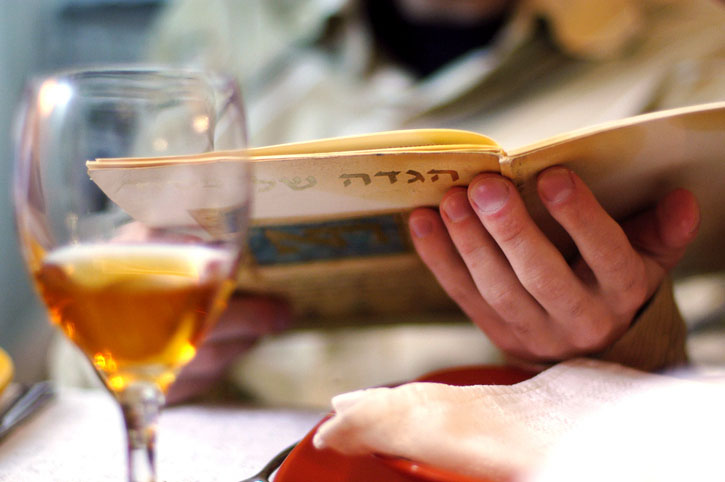
That means, "Why is this night different from all other nights," in Sranan.
But what's Sranan, you ask? Sranan is the primary language spoken in South America's Suriname, which has one of the oldest Jewish populations on the American continent. Is is also spoken in Aruba, Netherlands and the Netherlands Antilles -- with a total of 426,400 speakers today.
Passover is also called the "Holiday of Spring," a time when green symbolizes new life. The color also represents all things eco-friendly, which serves as the inspiration for this year's Workmen's Circle community seder.
"Avadim Hayinu," one of the first refrains of the Passover seder, usually refers to the fact that we were slaves to Pharaoh in Egypt. "What enslaves us as men," is another interpretation -- this at The Man Seder, the third annual men-only pre-Passover gathering, which takes place at American Jewish University this year on April 13.
Last year, when Newsweek published its inaugural list of America's 50 most influential rabbis, Jay Sanderson, one of the list's creators, said he was surprised by how much buzz it generated.
As usual, it started out with questions.
"Where do you work? What do you do? Have you been on any trips lately?"
I was all for talking about myself, what I do, where I've been, where I'm going. But then it got personal.
Daniel Sokatch, leader of one of Los Angeles' most high-profile Jewish organizations, has been named CEO of the Jewish Community Federation of San Francisco, the Peninsula, Marin and Sonoma Counties (JCF). He will start at the JCF on July 15.
In 2006, Rabbi Nancy Myers of Westminster's Temple Beth David used her Rosh Hashanah sermon to address the horrors of the Abu Ghraib scandals.
She was about to make a point about acting morally as Jews when a congregant walked down the sanctuary's aisle with his hands crossed in a time-out signal. Myers, new at the time to the Reform synagogue, thought the interruption was because someone had had a heart attack, so she stopped talking.
No politicians. No famous people.
Those were some of the rules that Donna Rosenthal set up for herself when writing, "The Israelis: Ordinary People in an Extraordinary Land" (Free Press), first published in 2003. A special edition -- updated with the most current events -- is being released April 1 to coincide with the 60th anniversary of Israel's founding
Yehuda Braunstein wasn't one of those kids whose childhood aspirations (to be a fireman, astronaut, actor) never came true. Even though he studied to be a mathematician at MIT and earned a doctorate at UC San Diego, and he also became religiously observant -- a ba'al teshuvah, through Chabad. Now, at 39, he's a mathematician, an active Chabad member -- and a clown.
The Simon Wiesenthal Center and Young Israel of Century City are holding a memorial rally on Sunday, March 9 at 4 p.m., in honor of the eight yeshiva students killed in a terror attack at Mercaz Harav in Jerusalem. StandWithUs and others will demonstrate in support of Israel in front of the Israeli Consulate at noon on Friday in response to a protest scheduled at the same time by the UC Irvine Muslim Student Union.
Book review of "The End of The Jews", a literary family saga built around three narratives in different time frames, opening with Tristan Brodsky, "15 years old, the sum total of five thousand years of Jewry, one week into City College, a mind on him like a diamond cutter."
Review of former Jewish Defense League member Brad Hirschfield's "You Don't Have to Be Wrong for Me To Be Right: Finding Faith Without Fanaticism" (Harmony Books, Random House, 2007).
Some people cap a career by writing a memoir or an exhaustive magnum opus based on a lifetime of research. But after eight books and 30 years at the Jewish Theological Seminary in New York as rabbi and professor, Burton L. Visotzky decided to write a novel. A work of Jewish historical fiction, to be more precise.
What exactly is the state of the pro-Israel peace movement in America? Does the Jewish institutional establishment represent the position of the American Jewish community? And if not, why are alternate voices not being heard?
Now, following the latest publishing craze of themed Jewish anthologies comes "Bread and Fire: Jewish Women Find God in the Everyday" (Urim Publications, 2008), edited by Rivkah Slonim (with consulting editor Liz Rosenberg). The 400-page compilation features writings from 60 women on topics including modesty, faith, childbirth, prayer, family, community, feminism and, in one way or another, Orthodox Judaism.
Tsilli Pines couldn't find a ketubah that she and her fiance liked. The Jewish wedding contract is often artfully handwritten and later framed as a wall decoration. But Pines, 33, a Portland, Ore.-based graphic designer, wanted something modern and simple. So she designed her own ketubah -- and then one for a friend.
As the Los Angeles Times' editor of the Op-Ed page and Sunday Opinion section, Nicholas Goldberg oversees publication of about four opinion pieces per day and eight to twelve on Sundays. The most volatile topic on those pages by far -- even more than the war in Iraq, the election campaigns or immigration -- is the Middle East and Israel.
Joy Horowitz's "Parts Per Million: The Poisoning of Beverly Hills High School" (Viking) is a dense 350-page book detailing a four-year fight between 1,000 litigants who claimed oil wells at the school caused diseases, such as cancer, and defendants -- including the oil companies, the city of Beverly Hills and school officials -- who said there had been no harmful effects from the (profitable) derricks.
When I was 25, my Orthodox girlfriends and I discussed at what age, if we weren't married, we might sleep with someone. The question was deeper than its "Sex and the City" nature might sound (although those girls had made that decision a long time ago).
When Ralph Salimpour was six years old in Esfahan, Iran, he had malaria -- a blood disease spread by infected mosquitoes that kills millions of people in the developing world every year.
On Dec. 19, 2007, the U.S. Attorney General's Office filed an indictment in the U.S. District Court for the Central District of California naming the Chasidic yeshiva and four other Spinka organizations, as well as eight people, in a multimillion dollar tax fraud and money-laundering ring that stretched from Brooklyn to Los Angeles to Israel and elsewhere.
It all started with powdered milk.
Last April, SOVA Community Food & Resource Program, which operates three food pantries and resource centers in Los Angeles, ran out of powdered milk, so the directors decided to solicit directly from their support network. They sent out a memo to local synagogues and schools asking for powdered milk donations.
"I'm pretty much your classic disaffected Gen-X kind of gal. I have too many shoes, I work too hard, I'm cynical, I'm broke. So when it came time for me to immerse before my wedding, I figured I'd bring some friends, we'd hang out, I'd get wet, we'd go eat, and that would be the end of it."
Historically, rabbis have proclaimed that in order to study kabbalah, one has to be a learned Jewish man older than of 40. So imagine how surprised those rabbis would be today if they could peruse a modern bookstore: There are now a plethora of tomes on the subject, making kabbalah available to the layperson -- male, female, Jew and non-Jew -- the dummy and idiot alike (which is it better to be?).
Breathe.
Yes, take a breath.
"One, long deliberate breath that you feel from the very beginning of it until the end of it. Try it, really. You can do it with your eyes open. You can do it while reading these instructions. Do you notice that you can feel your body, and especially your chest expanding and relaxing to accommodate the air flowing in and out, without stopping reading?"
But what is the real origin of gelt? Is it, as my father claimed, really a long-held Jewish custom? And how did gelt evolve from money to chocolate? And why does the chocolate taste so waxy? If gelt is here to stay -- if it's going to really represent the Jews like mistletoe and holly do the Christians -- are there any better options than the molten coins of our childhood? These are some of the questions I had as I set out on my journey in search of gelt.
So it should be no surprise that when the New York-based, albeit national, newspaper, The Forward, published its Forward 50 -- naming its version of this year's most influential Jews -- only six hail from Los Angeles. Does it matter where they're from?
Interview with Rabbi Marvin Hier who created the Simon Wiesenthal Center, the Museum of Tolerance and Yeshiva University of Los Angeles (YULA).
Briefs.
But they can't give me credit -- only God can. It says if you make three successful shidduchim, three matches, you automatically go to heaven. And this High Holy Day season I was thinking that I'd really like an automatic pass. ("Go directly to heaven. Do not pass hell; do not collect $200.) Three should be easy enough. I meet so many guys who just because they aren't for me doesn't mean they wouldn't be good for someone. What if this is my purpose in life? What if the point of my meeting so many people is to serve as what Malcolm Gladwell, in his book, "The Tipping Point," calls "The connector?" I feel heady with possibilities.
Pressman and the group did create another entity, what has become known as "The Library Minyan," named for the downstairs library where the 15 families began to meet weekly to pray. Members organized and participated in all parts of the service (especially the weekly sermon), discussed all aspects of Judaism and debated the increasingly complex issues of the changing times.Thirty-six years later, the Library Minyan, with its opportunities for engagement and intellectual rigor is seen as having helped to start a revolution -- empowering lay leaders in the essential structure of spiritual leadership. It has become a model for many Conservative and Reform congregations seeking to create alternatives both within and outside the fold of conventional synagogue structure, and has allowed individual congregations to morph it into new and ever-changing incarnations.This weekend, the Library Minyan will celebrate its double-chai anniversary (two times "life") with a Shabbaton Nov. 2-4 that will remember the past but also look toward the future.
Community briefs.
Scholars, clergy and seminarians gathered this week at the Luxe Hotel to discuss troubling passages and ideas in Christianity, Judaism and Islam, and ways of understanding them in modern times, as part of "Troubling Traditions: Wrestling With Problem Passages," a conference co-sponsored by the Board of Rabbis of Southern California and the Center for Christian-Jewish Understanding of Sacred Heart University.
So while the book, which is categorized as "humor," may explain religion in a palatable way to the many secular rationalists in the Blue States who would never understand it from a religious person's point of view, "The Year of Living Biblically" can remind even the faithful, even those who "pick and choose" their levels of observance, why they do what they do. And that's not annoying.
It's another bright sunny day in Encino, but Deborah Gordon manages to almost outshine the sun. In her hot pink and purple ensemble -- from ankle-length skirt to long-sleeved blouse topped by a fuchsia hat -- this rebbetzin wasn't kidding when she said she was all about colors.
Today I received the 50th e-mail from someone I vaguely know, someone who isn't spam, but is spam of a different sort. "You are invited to join LinkedIn."
As Cantor Sarah J. Sager began her research, she found there were many people -- both women and men -- who were thinking about the silence of women in the Jewish tradition, and working to create "a sense of women's presence at the most important moments of our history and in our most sacred text," Sager later wrote. But there was no one place to find all that commentary. Fifteen years later, the WRJ is publishing "The Torah: A Women's Commentary," edited by Tamara Cohn Eskenazi, a professor at the Los Angeles branch of Hebrew Union College-Jewish Institute of Religion.
It's the season to be sorry. It's that time of year when we go over all of our deeds, things we have done to others, to God, to ourselves and ask for forgiveness -- and grant it to those who need it from us.
Anyway, what does it mean to be happy? Does it mean to experience constant pleasure? Bouts of joy? Moments of ecstasy? Does it mean to suffer no pain? Never be sad? Never struggle with challenges? Whatever it is, how does one get happy? It's a High Holy Days challenge if ever there were one, since if we all lived happier lives, wouldn't the world be a better place?
One day, Dinah Berland was browsing in Sam Johnson's Book Shop on Venice Boulevard in Mar Vista, and in the Judaica section, tucked between the tomes, she noticed a slim, well-worn volume with a mysteriously blank spine. She picked it up out of curiosity -- later she would say it was fate -- and she found that the book spoke to the heart of her suffering at the time.
With 167 high schools and colleges serving 100,000 students, the independent, apolitical ORT Israel system is taking over many Israeli schools, teaching a curriculum of both technology -- from the cutting edge of satellites and nanobiotechnology to the basic nuts and bolts of mechanical engineering -- and instilling Jewish values of giving back to society. With these two focal points, ORT Israel hopes to revolutionize the Israeli educational system -- and Israeli society.
The weird thing about mixed seating in synagogue is that sometimes couples are all over each other. Inappropriate during prayer time for sure, but somewhat more distracting when one half of that couple happens to be a guy you once dated.
Where should you donate your money? How? How much? How do you know if you're getting your money's worth?
Indeed, immigrant communities often struggle with loyalties to the social mores of their old country and their new one. In the world of philanthropy and volunteerism, many Jewish leaders have learned that immigrant Jewish communities also have attitudes different from their American-born Jewish brothers and sisters. Those attitudes stem from the political systems and types of communities from which they came and what was expected of them in their native lands.
Tisha B'av is the Fast commemmorated on the ninth day of the month of Av. It begins at sunset Monday July 23, 2007 and ends at nightfall on July 24.
"Ridiculous."
"Solipsistic."
"Paganistic."
"Idolatrous."
"Dangerous."
This is how Los Angeles rabbis reacted to "The Secret," the best-selling DVD and book that has sold millions of copies and has all the trappings of a widespread religious/spiritual/self-help/New Age phenomenon.
"Now, once again, a group of gifted scholars gather to reinterpret the Jewish project, to reassert its meaning, re-envision its institutions and reimagine its future," asserts the introduction of the new book: "Jews and Judaism in the 21st Century: Human Responsibility, the Presence of God and the Future of the Covenant," edited by Valley Beth Shalom's (VBS) Rabbi Edward Feinstein (Jewish Lights Publishing, $24.99).
After a one-year search and some private soul-searching, Shaarey Zedek congregation in Valley Village has appointed a new rabbi. Rabbi Jonathan Rosenberg, who joined the congregation in March, was formally welcomed last month at the Orthodox synagogue's annual dinner.
A Jewish group is calling for a boycott of the Hilton Hotel group, which this week is hosting an Orange County conference sponsored by Al-Awda, the Palestine Right to Return Coalition (PRRC).
In the past decade, as Jewish leaders grapple with how assimilation and intermarriage have affected the numbers of Jews, many Jewish organizations, temples and synagogues are increasing efforts to reach out to teach Judaism -- both to secular and unaffiliated Jews, as well as to interfaith families.
Lag B'Omer, literally the 33rd day of the counting of the Omer -- the period between Passover and Shavuot -- is a relatively minor Jewish holiday that in recent years has become more popular among spiritually seeking Jews. It marks the day that the plague that killed 24,000 of Rabbi Akiva's students ended; it also marks the anniversary of the death of Rabbi Shimon Bar Yochai, who some think wrote the primary Kabbalistic text, the Zohar. The holiday has always been observed by the Orthodox, and in Israel, it's celebrated nationally and is a school holiday, but these days, some non-Orthodox synagogues, Jewish youth and singles groups and others have also taken to the beach to build fires, sing and revel in the fun.
A new Jewish mother is emerging in the 21st century among women who have learned the lessons of their mothers and grandmothers, yet are carving out territory of their own -- in many different versions.
When people talk about the Jewish mother stereotype, they're usually referring to the American Ashkenazi Jewish mother stereotype. But what about Jewish mothers from different cultures and countries?
Last Sunday's Israel Independence Day Festival at Woodley Park attracted 25,000 people -- Israelis and supporters of Israel, and some just out for the fun of it. Here are some of their pictures and stories.
People say they don't really know me. That's what the last guy I dated said.
Religion briefs.
But for thousands of people like Flor, slavery is not a thing of the past. Slavery is, in fact, very much alive in the world today. Twenty-seven million people are working as indentured slaves in the world today, according to Kevin Bales, author of "Disposable People: New Slavery in the Global Economy" (University of California Press, 2000), the first worldwide study of human slavery. Bales is also president of the organization Free the Slaves, a nonprofit organization based in Washington, D.C., dedicated to ending slavery around the world.
Mirror, mirror on the wall, who is the most influential American rabbi of them all? Rabbi Marvin Hier of the Simon Wiesenthal Center in Los Angeles, according to a list published Monday in Newsweek. An article titled "American Jews: The List -- Choosing the Chosen," rates America's 50 most influential rabbis -- with three of the top five working in Los Angeles (a total of 11 Angelenos are named).
The "Genocide and Religion: Victims, Perpetrators, Bystanders and Resisters" Synoposium went deeper than many such conferences by examining as many as possible of the various groups involved in a genocide -- the perpetrators, the victims, the bystanders and resisters -- all of whom can be found in every such conflict, past and present.
I didn't exactly mean to go incognito, but when my friend Ben didn't recognize me -- even after chatting with me for a minute at the noisy Purim carnival -- I realized I was onto something: I could be anyone.
Can the history of a nation be told through its music? If that nation has only been around for about 60 years, it's conceivable.
The sight of men in uniform dragging religious Jews away provokes a visceral reaction in any Jew: nausea, cramps, tears. It evokes the images of the Holocaust, no matter how dissimilar the situation may be.
Rabbi Dan Ehrenkrantz, president of the Reconstructionist Rabbinical College (RRC) in Philadelphia, recently made one of his biannual visits to Southern California.
"When you're out in the water, when you see the sunrise or sunset, and when you see how small you are in comparison to the massive water, and the current and waves, it humbles you," Shoshtain said. "Everything in nature connects you to spirituality, if it's done properly."
Welcome to Southern California's new world of Gourmet Kosher. As America has fallen in love with food over the last decade, the kosher world has not been too far behind.
Herzog is just one of many kosher labels around the world that hope to change the image of kosher wine. It's a two-pronged battle: The first is to change the perception of kosher wines in the mainstream world; the second is to change the kosher wine drinker's palate to appreciate finer wines.
Not everyone can be a matchmaker. And not every match that's offered is one that should be taken up.
Even though I can readily explain the concept of the World to Come ("Did you hear the one about the rabbi in heaven posted next to the blonde in the bikini?"), eschatology isn't my really my strong point, and I'm not sure it's the point of Judaism.
Let me state for the record: I am a trendsetter.
This just in, according to no less an authority than The New York Times. Based on their most recent census analysis, more American women are living without a husband than with one.
Many people took it upon themselves to raise vast sums of money for Israel during the conflict with Lebanon this summer, but how many were still in elementary school?
Many interfaith couples are raising their children to be Jews, even without conversion of the non-Jewish parent.
Updates. Pluralistic Rabbinical Court Seeks New Funding. InterfaithFamily.com Celebrates 200th Issue. OU Offers $20,000 Award for Best Unaffiliated Outreach.
When I turned 18 years old, my parents gave me a pair of diamond earrings. Later that same night at a comedy club, when a comedian on stage asked me what I got for my birthday, I showed him the diamonds.
"You must be Jewish, right?" he said.
I was -- still am, as a matter of fact. But I didn't know yet about Jews and diamonds. I'm not talking about the diamond industry, in which Israeli and Diaspora Jews are heavily involved, but in the purchase and wearing of diamonds.
What does it mean to be your brother's keeper? Lessons from the Cleveland kidnappings